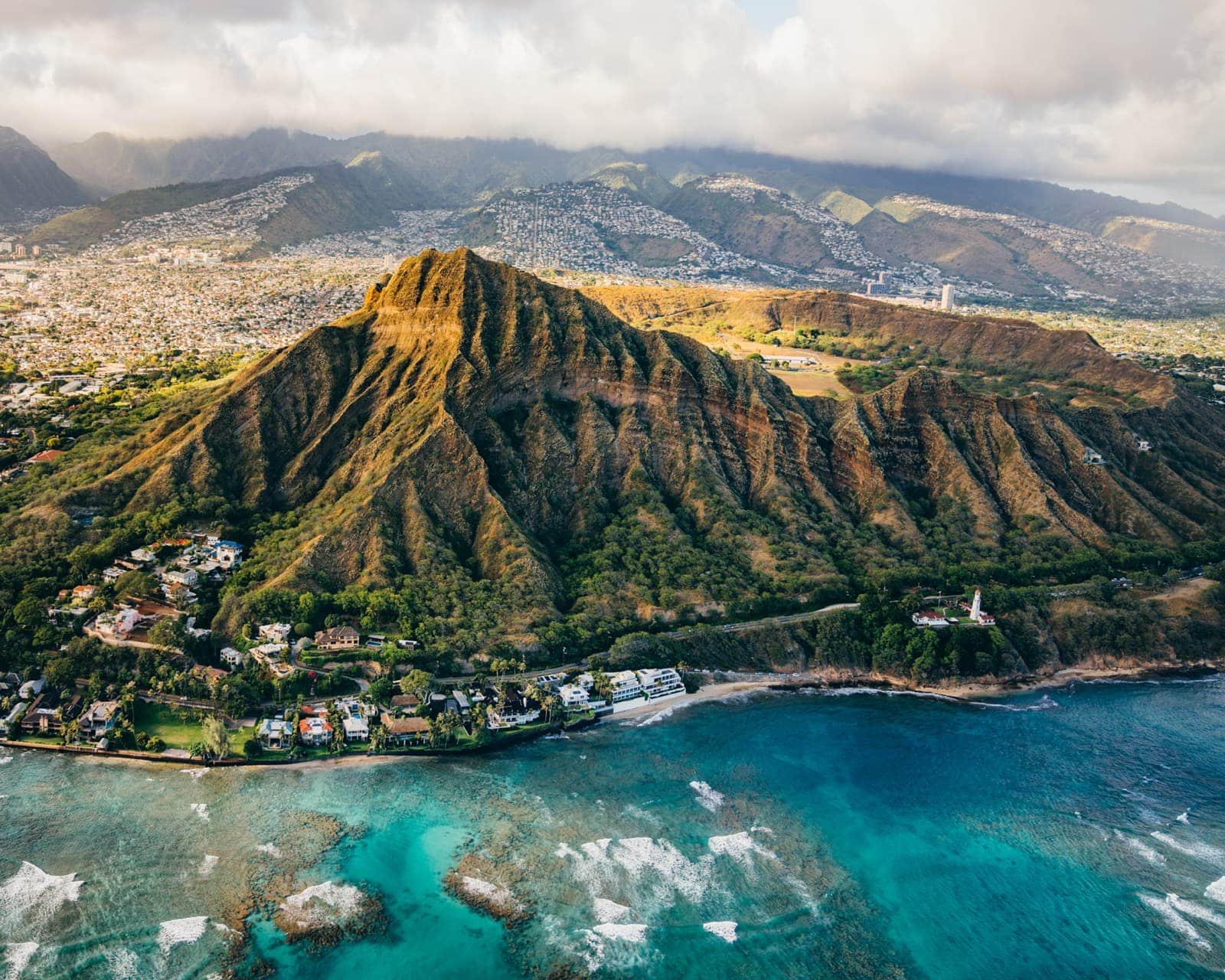
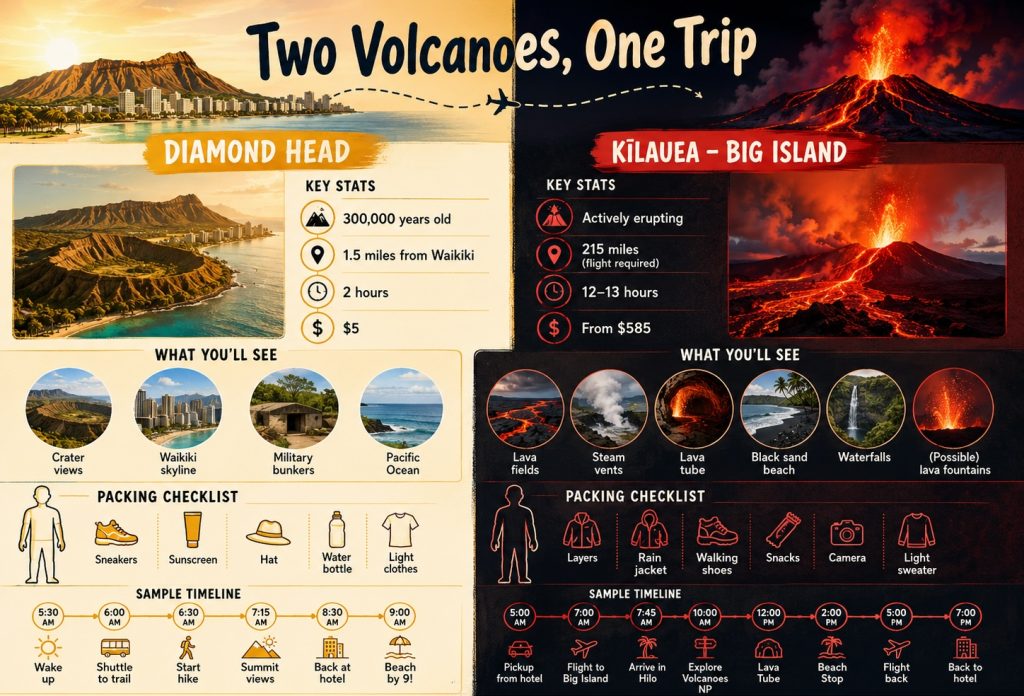
Most visitors to Waikiki don’t realize they’re already standing on one. Diamond Head — the volcanic crater visible from every hotel balcony — is a 300,000-year-old tuff cone you can hike in under two hours. But if you want to see an active volcano, that means a day trip to the Big Island, where Kīlauea has been erupting in spectacular lava-fountaining episodes since December 2024.
This guide covers both experiences: the quick volcanic hike right in Waikiki and the full-day adventure to Hawai’i Volcanoes National Park. Plus the practical details — what to wear, what it costs, whether you’ll actually see lava, and which tour is worth your money.
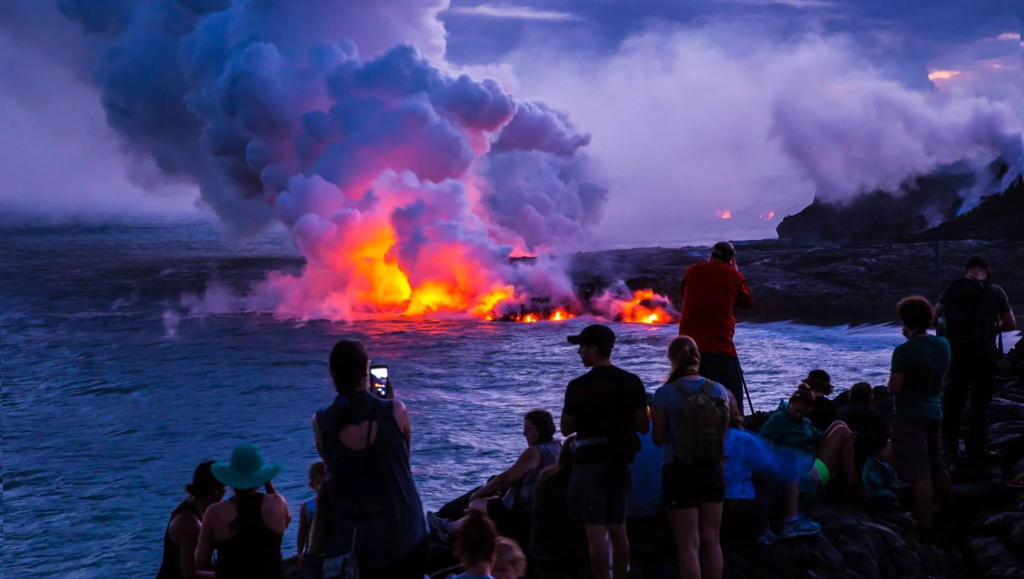
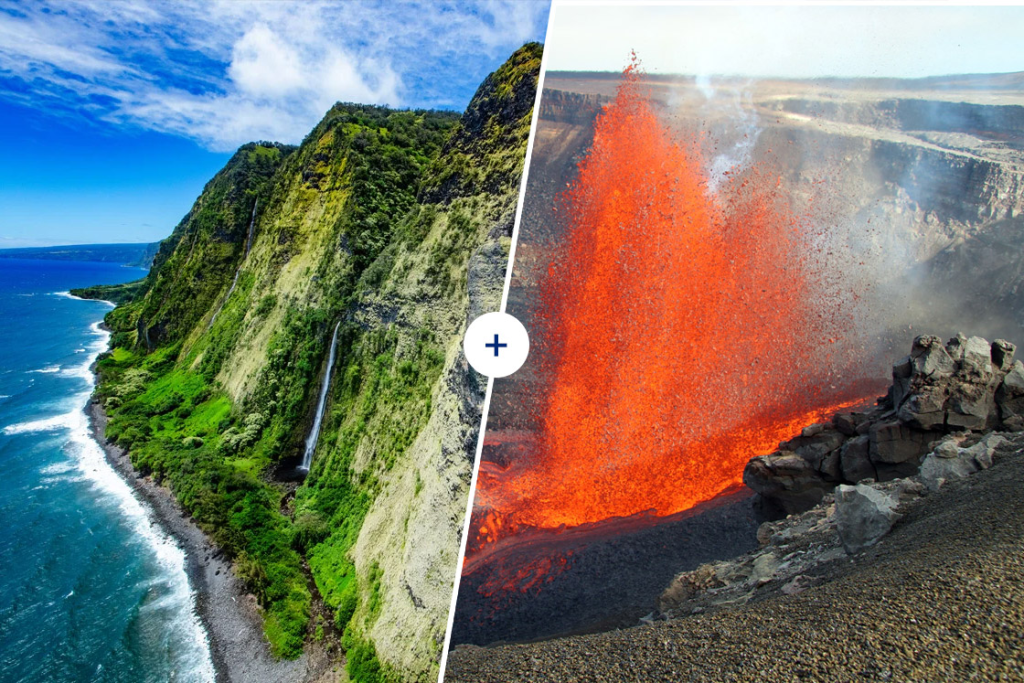
Featured: Big Island Volcano Day Trip from Waikiki
The only way to see an active volcano from Oahu — everything included.
⏱ Duration: 12–13 hours door-to-door (Waikiki hotel pickup to drop-off) 💰 Price: From ~$585 USD per person (flights, transfers, park admission included) 📍 Pickup: Waikiki hotels, 4:30–6:30 AM depending on flight time 📅 Available: Year-round (best weather March–October) 👥 Group size: Small group (8–14 passengers) ⭐ Rating: 4.7/5 (1,100+ reviews) ✈️ Includes: Round-trip flights Honolulu–Hilo, all ground transport, Hawaiʻi Volcanoes National Park admission, expert guide
Key stops: Kīlauea Caldera viewpoints, Halemaʻumaʻu Crater overlook, steam vents, Nāhuku (Thurston) Lava Tube, Chain of Craters Road, Rainbow Falls, Richardson Ocean Park (black sand beach), Liliʻuokalani Gardens, Hilo town & Big Island Candies.
Not included: Lunch (~$15–20 at a Hilo restaurant), personal snacks, gratuity for guide.
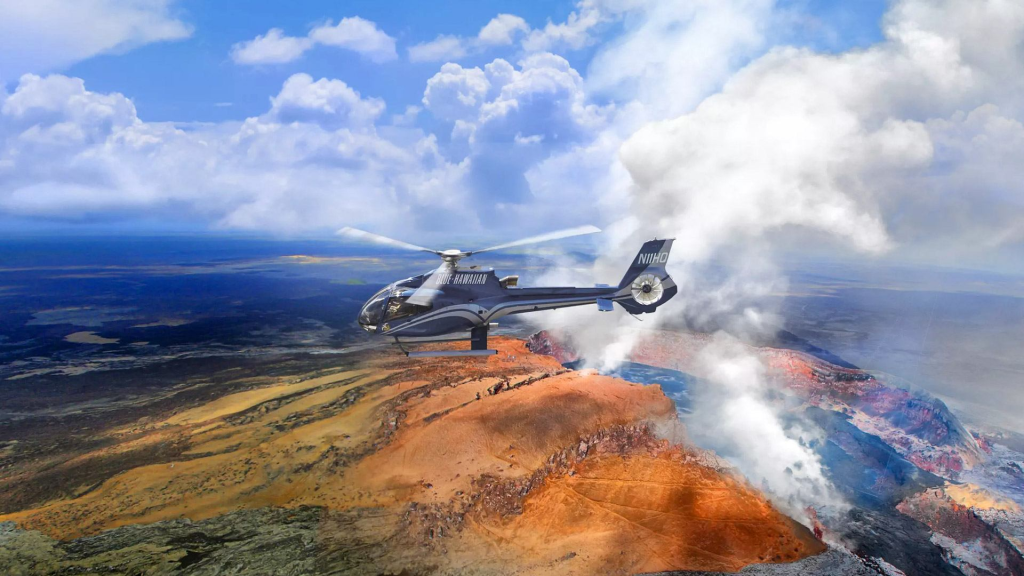
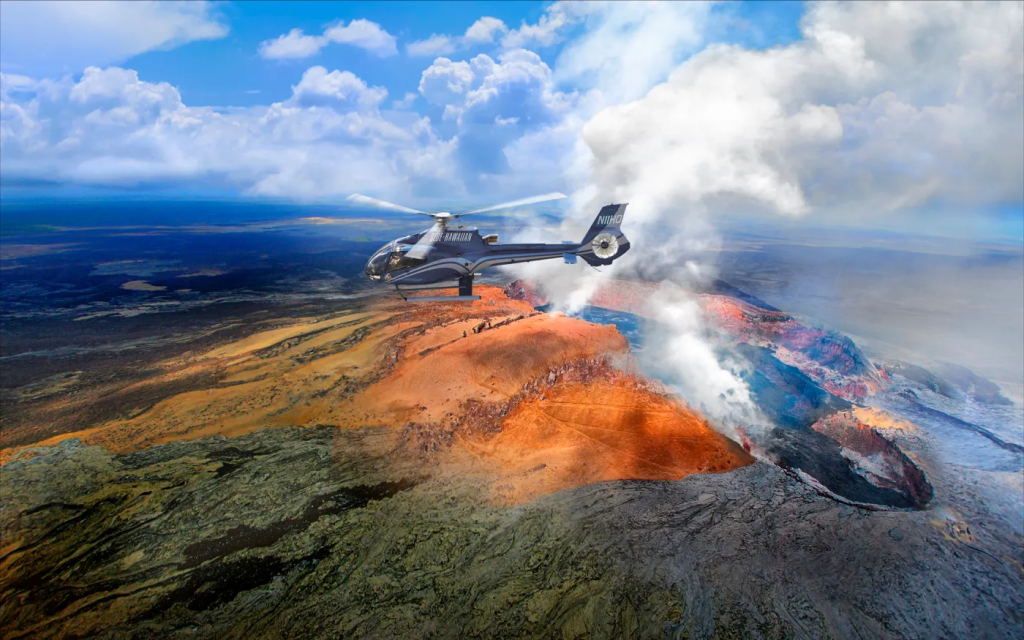
Want the helicopter upgrade? Add a 45-minute helicopter flight over Kīlauea’s lava fields, coastline, and waterfalls:
⏱ Duration: ~16 hours | 💰 From ~$842 per person
Can You Actually See a Volcano from Waikiki?
Yes — two, in fact.
Diamond Head (Lēʻahi) is the volcanic crater literally next to Waikiki Beach. It’s extinct (last erupted ~300,000 years ago), but you can hike to the summit and stand inside the crater. It’s the most recognizable landmark in Hawaiʻi and takes about 2 hours round trip. No tour needed — just a reservation and a pair of sneakers.
Kīlauea, on the Big Island, is one of the most active volcanoes on Earth. As of May 2026, it’s in an ongoing episodic eruption cycle — lava fountains reaching 200+ metres (650+ feet) have been erupting every 1–3 weeks since December 2024. You can’t see it from Oahu (it’s 215 miles away), but day trips with round-trip flights get you there and back in a single day.
There are no active volcanoes on Oahu itself. Diamond Head, Koko Head, and Punchbowl are all long-extinct volcanic formations. For flowing lava and volcanic activity, you need to get to the Big Island.
Option 1: Diamond Head Hike — The Volcano in Your Backyard
| Detail | Info |
|---|---|
| Location | Diamond Head State Monument, 1.5 miles from Waikiki Beach |
| Distance | 1.6 miles (2.6 km) round trip |
| Elevation gain | 560 feet (170 m) |
| Time | 1.5–2 hours round trip |
| Difficulty | Moderate — steep stairs at the end |
| Hours | 6:00 AM – 4:00 PM (gates lock at 6:00 PM) |
| Entry fee | $5 per person (non-resident) · $10 parking per car |
| Reservation | Required in advance — book at hawaiistateparks.org |
| Age | All ages (not recommended under 3 or over 65 with mobility issues) |
What to Expect
Diamond Head is a tuff cone — a type of volcanic crater formed by a single explosive eruption roughly 300,000 years ago. You start inside the crater floor, then climb a paved switchback trail that transitions to uneven volcanic rock, steep metal staircases, and a 225-foot tunnel built for military use in 1908. At the summit, you get 360-degree views of Waikiki, Honolulu, the Pacific, and the Koʻolau Mountains.
The trail is short but genuinely steep at the end. The final staircases are narrow and exposed — on busy days, you’ll queue to climb them. The heat can be intense; there’s almost no shade.
How to Get There from Waikiki
You have several options, roughly in order of convenience:
Shuttle tour ($25–40 per person) — The easiest option. Includes Waikiki hotel pickup, park entry, and return shuttle. You don’t deal with parking or reservations.
Waikiki Trolley — The Green Line stops at Diamond Head. A day pass costs ~$25. Good if you want to hop on and off at other stops too.
Rideshare (Uber/Lyft) — ~$15 each way from central Waikiki. About 10 minutes.
Drive yourself — 15 minutes from Waikiki. Parking inside the crater is $10 per car but fills up fast. Arrive before 7:00 AM for a spot.
City bus — TheBus Route 2 or 23. ~$6 round trip per person. Walk 15 minutes from the bus stop to the trailhead.
Diamond Head Tips
- Go early. The first reservation slot (6:00 AM) is the least crowded and coolest. By 9:00 AM, the trail is packed and hot.
- Bring water. There are vending machines at the trailhead but nothing on the trail. At least 1 litre per person.
- Wear closed-toe shoes. The trail has loose gravel and steep metal stairs. Flip-flops won’t cut it.
- Book your reservation online beforehand. You can’t just walk in.
- Allow 2 hours total. The hike itself takes 45–60 minutes up, but factor in the summit views, the descent, and any queuing on the stairs.
- Self-guided audio tour ($12) — worth it if you’re interested in the geological and military history.
Option 2: Big Island Volcano Day Trip — See Kīlauea Up Close
This is the real deal: a full-day trip from Waikiki to Hawaiʻi Volcanoes National Park on the Big Island, with round-trip flights, guided touring, and hotel transfers all included.
Kīlauea Eruption Status (May 2026)
Kīlauea is currently in an ongoing episodic eruption. Since December 23, 2024, there have been 47 episodes of lava fountaining in the Halemaʻumaʻu crater. Fountains have reached up to 270 metres (900 feet) in height. Episodes last anywhere from 8 hours to 8 days, separated by 1–3 week pauses.
As of May 17, 2026: The eruption is paused after Episode 47 ended on May 15. USGS forecasts Episode 48 between May 22–25.
Will you see lava? It depends on timing. If you visit during an active fountaining episode, you may see lava fountains and glowing flows from designated overlooks inside the park. During pauses, you’ll see steaming vents, glowing crater floors at night, and the dramatic aftermath of recent flows — but no active lava. The park is worth visiting either way; the landscape is unlike anything else on Earth.
Pro tip: Follow the USGS Kīlauea daily updates in the days before your trip. If an episode is forecast, try to schedule your tour accordingly. If you have flexibility, book your volcano day trip for early in your stay so you have backup days if needed.
What the Tour Includes — Step by Step
4:30–6:30 AM: Pickup from your Waikiki hotel. Transfer to Honolulu Airport (HNL).
~7:00 AM: Inter-island flight to Hilo (~45 minutes). Your guide meets you at Hilo Airport.
Morning: Rainbow Falls (80-foot waterfall cascading over a lava cave), Liliʻuokalani Japanese Gardens, and a drive through downtown Hilo.
Midday: Hawaiʻi Volcanoes National Park — the heart of the tour. You’ll visit:
- Kīlauea Visitor Center — orientation, exhibits, ranger updates on current volcanic activity
- Kīlauea Caldera Overlook — stand on the edge of one of the world’s most active volcanoes
- Halemaʻumaʻu Crater viewpoint — the site of the current eruption (visible from designated overlooks)
- Steam Vents — volcanic heat meets groundwater, creating plumes of steam
- Nāhuku (Thurston Lava Tube) — walk through a 500-year-old lava tunnel formed by flowing lava
- Chain of Craters Road — a dramatic drive past craters, lava fields, and old eruption sites down to the coast
Afternoon: Richardson Ocean Park (black sand beach — yes, the sand is really black), lunch stop in Hilo (not included, budget ~$15–20), Big Island Candies (chocolate and macadamia nut factory).
~4:00–5:00 PM: Flight back to Honolulu. Transfer back to Waikiki hotel.
~6:30–7:00 PM: Drop-off at hotel. Total door-to-door time: ~12–13 hours.
Tour Options Compared
| Tour | Price | Duration | Highlights | Best For |
|---|---|---|---|---|
| Big Island Volcano Day Trip | From $585 | 12–13 hrs | Flights + full guided tour of Volcanoes National Park, Hilo, waterfalls, black sand beach | Most visitors — complete experience, all logistics handled |
| Volcano + Helicopter Combo | From $842 | ~16 hrs | Everything above + 45-min helicopter over Kīlauea, lava fields, coast & waterfalls | Photographers, bucket-list seekers, those wanting aerial views |
| Big Island “BIG Volcano” from Kona | From $247 | Full day | Ground tour of Volcanoes National Park from Kona side | Travelers already staying on the Big Island (no flights included) |
What to Wear & Bring: Packing for Each Experience
For Diamond Head
Diamond Head is at sea level in Honolulu — it’s hot.
| Item | Why |
|---|---|
| Closed-toe shoes (sneakers fine) | Loose gravel, steep metal stairs |
| Sunscreen + hat | Almost zero shade on the trail |
| 1+ litre water per person | No water on the trail |
| Light, breathable clothing | Expect 25–35°C (75–95°F) |
| Phone/camera | Summit views are spectacular |
Don’t bring: Heavy hiking boots (overkill), flip-flops (dangerous on stairs), umbrellas (wind at summit).
For the Big Island Volcano Day Trip
The Big Island is a different climate zone. Hawaiʻi Volcanoes National Park sits at 4,000 feet (1,200 m) elevation — it’s cooler, wetter, and windier than Waikiki.
| Item | Why |
|---|---|
| Layers — light jacket or fleece | Park is 10–15°C cooler than Waikiki (often 15–20°C / 60–68°F) |
| Rain jacket or windbreaker | Rain is frequent, especially in Hilo/park area |
| Closed-toe walking shoes | Lava rock is sharp and uneven, especially in the lava tube |
| Sunscreen + hat | Sections of Chain of Craters Road are exposed |
| Snacks + water | Lunch is not included; long day with limited food stops |
| Camera with charged battery | You’ll want it for the crater, waterfalls, and black sand beach |
| Light sweater for the plane | Inter-island flights can be cold |
Don’t bring: Swimsuit (no swimming stops on the standard volcano tour), heavy hiking gear (the walks are short and easy), lava rocks (it’s illegal to remove rocks from the national park — and Pele’s Curse says it brings bad luck).
Best Time to Visit: When to Go & What to Expect
Diamond Head
Open year-round, daily 6:00 AM – 4:00 PM (last entry). Best in the early morning (6:00–8:00 AM) before it gets hot and crowded. Slightly cooler and less crowded November–March but still busy. Avoid midday in summer.
Big Island Volcano Day Trip
Available year-round, but conditions vary:
| Season | Weather at the Park | Crowds | Lava Viewing Chance |
|---|---|---|---|
| March–May | Warm, moderate rain | Moderate | Good — Kīlauea erupting episodically |
| June–August | Warmest, drier | High — book early | Good — same eruption cycle |
| September–November | Warm, increasing rain | Lower | Good — still erupting |
| December–February | Cool, wettest | Low–moderate | Good — current eruption began Dec 2024 |
Key insight: The volcano itself doesn’t have a “season.” Kīlauea erupts based on geological cycles, not the calendar. As of 2026, the eruption has been ongoing for 18 months with no signs of stopping. The real variable is weather — rain and fog can obscure crater views. Mornings tend to have clearer skies.
Diamond Head vs. Big Island Day Trip: Which Should You Do?
| Diamond Head | Big Island Volcano Day Trip | |
|---|---|---|
| What you see | Extinct volcanic crater, summit views of Waikiki | Active volcano (Kīlauea), lava tube, crater, lava fields, waterfalls, black sand beach |
| Active lava? | No — extinct for 300,000 years | Possible — depends on eruption timing |
| Time needed | 2–3 hours | 12–13 hours (full day) |
| Cost | $5 entry + transport (~$25–40 total) | From $585 per person (all-inclusive) |
| Physical effort | Moderate — 560 ft elevation, steep stairs | Easy — short walks, mostly vehicle-based |
| Distance from Waikiki | 1.5 miles (10 min drive) | 215 miles (requires flight) |
| Best for | Quick morning activity, all fitness levels | Once-in-a-lifetime volcanic experience |
| Do both? | Yes — Diamond Head in the morning, volcano day trip on another day |
Our recommendation: Do both if your schedule allows. Diamond Head is a 2-hour morning activity that pairs with a beach afternoon. The Big Island day trip is a separate full day. They’re completely different experiences — one is a scenic hike with city views, the other is standing on the edge of one of the world’s most active volcanoes.
Other Top Tours from Waikiki
While you’re on Oahu, these are the most popular experiences — and they all depart from Waikiki with hotel pickup.
Circle Island Tour (Oahu’s Greatest Hits)
See the entire island in one day: North Shore, Dole Plantation, Kualoa Ranch lookout, Halona Blowhole, Hanauma Bay overlook, and more.
⏱ 6–10 hours | 💰 From ~$50–130
Snorkeling & Sailing
Snorkel with sea turtles off Waikiki Beach on a sailing catamaran.
⏱ 2–3 hours | 💰 From ~$80
Sunset Cruise
Evening catamaran cruise off Waikiki with snacks, drinks, and Friday fireworks viewing.
⏱ 1.5–2 hours | 💰 From ~$65
Common Mistakes Visitors Make
- Thinking they’ll see lava on Oahu. There is no active volcano on Oahu. Diamond Head, Koko Head, and Punchbowl are all extinct. For lava, you need the Big Island.
- Showing up at Diamond Head without a reservation. Entry requires advance booking since May 2022. No reservation = no entry.
- Hiking Diamond Head at midday. It’s shadeless and 30°C+. Go at 6:00 AM.
- Wearing flip-flops to Diamond Head. The summit has metal staircases and loose rock. Closed-toe shoes are essential.
- Not dressing warm enough for the Big Island. Hawaiʻi Volcanoes National Park is at 4,000 feet. It can be 15°C cooler than Waikiki. A light jacket is non-negotiable.
- Expecting guaranteed lava on the Big Island tour. Kīlauea’s eruption is episodic — fountaining lasts hours to days, then pauses for 1–3 weeks. Check USGS updates before booking.
- Skipping lunch money on the Big Island day trip. Lunch isn’t included, and there’s only one stop to eat. Bring snacks and $15–20 for a meal.
- Removing lava rocks from the national park. It’s illegal (federal land) and culturally disrespectful. Locals say Pele’s Curse will follow you home.
- Not booking the Big Island trip early in your stay. If weather or volcanic conditions cause changes, you want backup days. Don’t schedule it for your last day.
FAQ
Is there a volcano in Waikiki? Diamond Head, the crater visible from Waikiki Beach, is an extinct volcanic tuff cone. It last erupted roughly 300,000 years ago and has no chance of erupting again. You can hike to its summit in under an hour — it’s one of the most popular attractions on Oahu.
Can you see lava in Hawaiʻi right now (2026)? Yes — Kīlauea on the Big Island has been in an ongoing episodic eruption since December 2024. Lava fountains reaching 200+ metres have been erupting every 1–3 weeks. However, seeing active lava requires timing your visit during a fountaining episode. Between episodes, the crater glows but lava isn’t flowing on the surface. Check the USGS Kīlauea updates for real-time status.
How do I get from Waikiki to Hawaiʻi Volcanoes National Park? The only practical way for a day trip is by inter-island flight from Honolulu (HNL) to Hilo (ITO) — about 45 minutes. Guided day tours from Waikiki include round-trip flights, hotel pickup, and all ground transportation. Self-driving isn’t possible; there are no roads between islands.
Is the Big Island volcano day trip worth the price ($585+)? For most visitors, yes. The price covers round-trip flights (~$200–300 alone), all ground transport, park admission ($30), and an expert guide for 7+ hours. Doing it independently would cost similar or more, with significantly more logistics. The tour handles everything — you just show up at your hotel lobby.
Can kids do these tours? Diamond Head: suitable for ages 3+ who can handle stairs. The Big Island day trip: suitable for all ages, including young children (car seat not provided — bring your own). The tour involves short, easy walks, not strenuous hikes.
What if it rains? Diamond Head: doable in light rain, but the stairs get slippery. The Big Island day trip operates rain or shine — the park is in a rainforest zone, and brief rain is normal. The lava tube, visitor center, and vehicle are all covered. Bring a rain jacket.
How far in advance should I book? Diamond Head: book your reservation at least 2–3 days ahead. Peak times (7:00–9:00 AM) fill up fast. Big Island day trip: book at least 1–2 weeks ahead, especially in summer (June–August). Flights and small group sizes mean limited availability.