 Oahu Volcano Tours
Active Volcanoes on Oahu: Where the Lava Actually Is
There are no active volcanoes on Oahu. The island's lava stopped long ago, and its famous craters are extinct tuff cones you can walk into. The active volcanoes on Hawaii sit on the Big Island, about 215 miles from Honolulu, where Kilauea has been erupting on and off since late 2024. This page separates the two honestly. It explains what Oahu's craters actually are, what Kilauea is doing right now, what a day trip to see it costs and involves, and what your odds of seeing open lava really are. For the full range of options, start at Oahu volcano tours compared.
Quick answer The short answer
There are no active volcanoes on Oahu. The island's two volcanoes, Waianae and Koolau, are extinct, and Diamond Head, Koko Crater, Punchbowl and Hanauma Bay are extinct tuff cones. The active lava is on the Big Island, where Kilauea has erupted 54 fountaining episodes since late December 2024, and a day trip there from Honolulu costs about $576 to $810.
Key takeaways
- The only way to see an active volcano in one day is a flight to Hilo or Kona. Compare the Big Island day tours.
- On Oahu itself you can walk into extinct craters. The Diamond Head crater hike needs a state reservation at $5 per person.
- Kilauea's fountaining episodes last under 12 hours, with two or more weeks of pauses between them. No tour can promise lava.
- The cheapest way to stand on volcanic ground on Oahu is a guided walk on the Koolau slopes from $90. See the Honolulu rainforest hike.
Oahu Has No Active Volcano
Start with the fact that answers the query, because it saves a wasted morning of expectations.
Two Extinct Shields and Four Tuff Cones
Oahu is built from two shield volcanoes, Waianae and Koolau, and both are extinct. Neither has erupted in recorded history. The island's last gasp of activity, the Honolulu Volcanics, left a ring of small tuff cones near the south-east shore. Diamond Head, Koko Crater, Punchbowl and Hanauma Bay are all part of that late series. They are made of ash and fragmented rock thrown up through shallow water, not of flowing lava.
That means the craters you can visit on Oahu are genuinely volcanic, and genuinely dead. Koolau's high point, Konahuanui, stands at 3,150 feet, and the island's highest summit, Mount Kaala, reaches 4,025 feet. Neither will ever glow. If you want the geology behind why the island stopped, the volcanic history of Oahu covers it.
What That Means for a Visitor
You cannot see red lava on Oahu, and no honest operator will tell you otherwise. What you can do is walk into a crater formed by a real eruption. Diamond Head's monument covers over 475 acres and the summit trail takes 60 to 90 minutes to walk. Koko Crater has a 1,048-step Second World War tramway up its side, with pillboxes and bunkers at the top. Hanauma Bay is a tuff cone flooded by the sea, and it became Hawaii's first Marine Life Conservation District in 1967.
The trail details for each of these live on their own pages, so this one stays on the question of what is active and what is not. The short version is everything on Oahu is not.
Sources: USGS and Wikidata entity records.
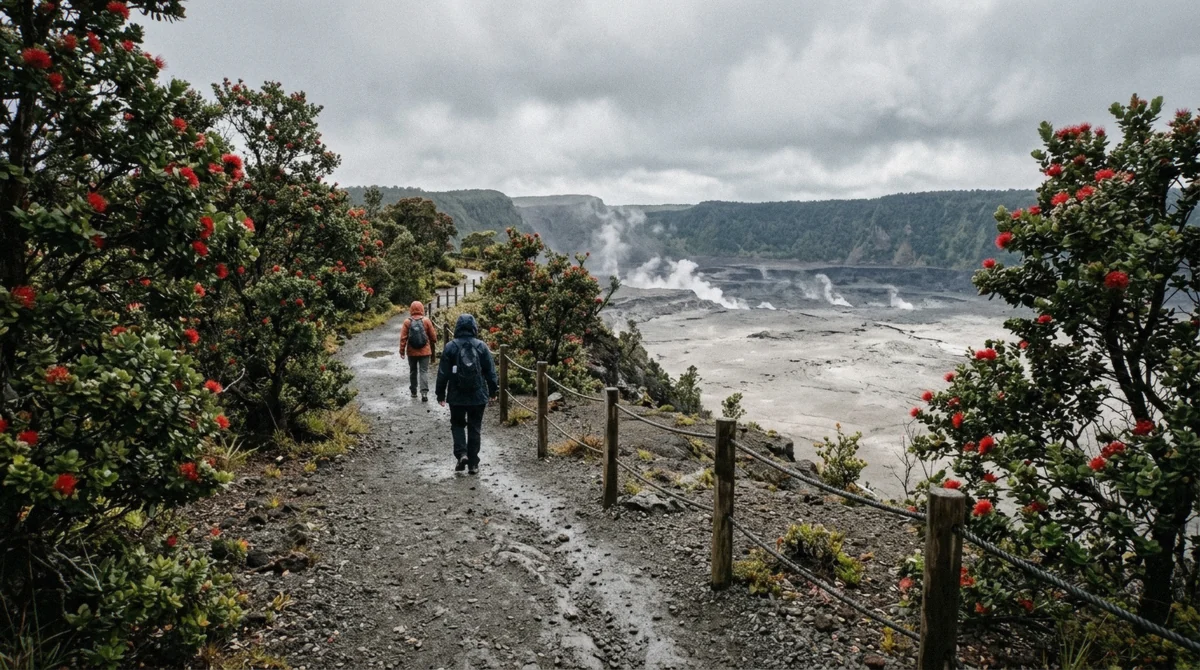
Where Hawaii's Active Volcanoes Actually Are
The active volcanoes sit on Hawaii Island, the Big Island, a short flight from Honolulu.
Kilauea's Current State
Kilauea, inside Hawaii Volcanoes National Park, has been erupting episodically from vents in Halemaumau crater since 23 December 2024. By the daily update of the USGS Hawaiian Volcano Observatory, it had run 54 fountaining episodes, the latest of which lasted about 9 hours and threw a fountain roughly 500 feet (150 m) high with a plume to about 17,000 feet (5,200 m). The alert level sits at WATCH with an aviation colour of ORANGE.
On the day this page was checked there was no active lava on the ground. The north, south and west vents glowed but had stagnated. Between episodes the summit still releases 1,000 to 5,000 tonnes of sulphur dioxide a day. What an episode actually looks like, and why the rhythm matters, is explained on the page about what erupting means in Hawaii.
The table below pulls together the status figures from the USGS daily update and the park's own alert list.
Status at a Glance
These are the checked figures for Kilauea and for access to the park around it. The Halemaumau crater rim has been closed to the public since late 2007, and the eruption sits inside a closed area of the park regardless of what it is doing.
| Item | Figure | Note |
|---|---|---|
| Alert level | WATCH | Aviation colour ORANGE |
| Episodes to date | 54 | Between 23 December 2024 and the September 2026 check |
| Typical episode length | Under 12 hours | Pauses of two or more weeks between episodes |
| Latest episode | About 9 hours | North vent fountain roughly 500 feet (150 m) |
| Sulphur dioxide between episodes | 1,000 to 5,000 tonnes a day | Summit release |
| Park entry by car | $30 per vehicle | Valid 7 days, no cash accepted |
Getting There From Honolulu
The park is about 215 miles from Honolulu as the plane flies. Daily flights run from Honolulu to Hilo on the island's east side, or to Kona on the west, and each leg takes about one hour. A door-to-door day trip, airport to airport with ground transport, runs 12 to 16 hours depending on the listing. The park itself is open 24 hours a day, 7 days a week, including holidays, though a two-year construction project at the summit is causing closures and delays.
If you are weighing the routes and the airports against each other, the page on how to get to Hawaii Volcanoes National Park from Oahu breaks them down.
Sources: USGS Hawaiian Volcano Observatory and nps.gov/havo.
Your Odds of Seeing Lava
This is the part most marketing skips, and it decides whether a day trip is worth $576 to $810 to you.
The Rhythm Works Against a One-Day Visit
A fountaining episode generally lasts less than 12 hours, and the pauses between episodes run two or more weeks. Fifty-four episodes spread across roughly 21 months works out to an episode roughly every 13 days. On any randomly chosen day, the most likely situation is no lava on the ground at all, which is exactly what the status check found here. Even during an episode, the eruption is inside a closed area, watched from distance rather than approached.
No tour, at any price, can promise you lava. What a tour can promise is the summit, the steam vents, the lava tube and the caldera landscape, all of which are there every day. The honest expectation is a volcano you can stand above, not a fountain you can watch.
If Seeing a Fountain Matters to You
Two things improve your odds. First, track the USGS daily update in the days before you book, because the pause patterns are public. Second, keep your booking flexible where you can. Of the day trips compared here, three carry free cancellation up to 24 hours before departure, while two are non-refundable at any notice. The difference matters when your travel dates are fixed and Kilauea's are not.
Also plan for the alert list. A tephra caution at the summit warns that ash, rock and glassy strands can irritate skin, eyes and airways, and the Sulphur Banks Bridge is closed until further notice, though the boardwalk stays open from the west side near the Steam Vents. The volcano safety page gathers the current cautions.
Sources: USGS Hawaiian Volcano Observatory.
What a Big Island Day Trip Costs From Oahu
Nine listings cover the route. The table compares every price and what each one buys.
The Full Price Comparison
The figures below come from the operator listings and cover every price, duration, rating and cancellation term of the day trips from Oahu to the active volcano, alongside the cheap ways to see extinct volcanic ground on Oahu itself. Read the cancellation column carefully, because the cheapest big-ticket option is also the least forgiving.
| Tour | Price | Duration | Rating | Cancellation |
|---|---|---|---|---|
| Volcano day tour, hotel pickup | $585 | 12h 30m | 4.7 from 70 reviews | Non-refundable |
| Volcano adventure with helicopter | $810 | 15h 30m | 4.2 from 40 reviews | Free cancellation 24h |
| Volcano adventure, no helicopter | $576 | 16 hours | 4.1 from 17 reviews | Free cancellation 24h |
| National park experience, Kona | $590 | 12 hours | 5 from 2 reviews | Free cancellation 24h |
| Volcanoes national park adventure | $680 | 1 day | 4.6 from 13 reviews | Non-refundable |
| National park experience, Kona | $589.99 | 12 hours | 4.75 from 272 reviews | Free cancellation 24h |
| Rainforest hike on Koolau slopes | $90 | 3h 30m | 5 from 6 reviews | Free cancellation 24h |
| Koko Crater sunset hike | $129 | 3h 30m | 5 from 1 review | Free cancellation 24h |
| Diamond Head sunrise shuttle | $64 | 3 hours | 4.3 from 491 reviews | Free cancellation 24h |
What the Cheapest Active-Volcano Day Buys
At $576, the Polynesian Adventure day without the helicopter is the cheapest way onto the Big Island in one day. It includes a picnic lunch in the park, the flight to Hilo, a small-group mini coach and free cancellation up to 24 hours before. You clear the airport yourself, and the listing puts the departure around 4am. The helicopter version costs $810, so the flight over the volcano is what the $234 gap buys.
The priciest option is the $810 helicopter day, which also spends 3 hours 50 minutes inside the park, the longest of any listing here. Be aware its listing contradicts itself on whether the helicopter is included or optional at extra cost, so confirm at checkout.
- Cheapest active-volcano day: $576, 16 hours, free cancellation 24h.
- Longest park time: 3 hours 50 minutes, on the $810 helicopter day.
- Strongest review record: 4.75 from 272 ratings, $589.99.
- Cheapest volcanic ground on Oahu: $90 for the Koolau rainforest hike.
Doing It Yourself Is Not Automatically Cheaper
Going alone means booking your own inter-island flight, renting a car, and paying the park's $30 per vehicle entry, valid 7 days, plus $25 for a motorcycle or $15 per person on foot. Add the return flight and a dawn start, and the arithmetic against a $576 tour gets tight, especially since a tour's coach carries the $100 or $200 commercial entry fee for you. The full breakdown, with the free and cheap alternatives, sits on the cost page and the budget options page.
Volcanic Ground Without Leaving Oahu
If extinct counts for you, Oahu gives you craters for the price of a shuttle.
Three Craters and a Bay
Some of the cost nothing or almost nothing to walk into, and the rules that catch visitors are the reservation windows rather than the prices. The figures come from the state and city pages that run each site.
| Crater | Entry | Hours | The rule that catches people |
|---|---|---|---|
| Diamond Head | $5 per person, $10 with parking | 6:00 a.m. to 6:00 p.m. | Non-residents reserve up to 30 days ahead and must arrive inside the first 30 minutes of the slot |
| Koko Crater | Free | No stated gate hours | 1,048 steps with no shade, so the heat decides the hour |
| Punchbowl | Free | See the cemetery's own hours | It is a national cemetery first and a crater second |
| Hanauma Bay | Paid, plus cash parking | Wednesday to Sunday, entry 6:45 a.m. to 1:30 p.m. | Reservations open only two days ahead at 7 a.m. Hawaii time |
The guided versions
For guided versions, the Diamond Head sunrise shuttle costs $64 with hotel pickup at 5:00 a.m., and the Koko Crater sunset hike is $129 with Waikiki pickup and a guide to the trailhead. Both walk extinct craters, so manage expectations accordingly.
A Guided Walk on a Real Shield
The Koolau range is one of Oahu's two extinct shield volcanoes, and a naturalist-guided rainforest hike on its slopes runs 3 hours 30 minutes for $90, with round-trip transport from 14 pickup points in Kahala, Waikiki and Aloha Tower. It involves 600 feet of climbing and the listing asks for above-average fitness, with no children under 8. On clear days you get views to Konahuanui at 3,150 feet and Mount Kaala at 4,025 feet.
It is not an eruption site, and it is the cheapest way to stand on volcanic ground on this island with someone who can explain it.
Sources: Hawaii State Parks, Honolulu Hanauma Bay, operator listings.
Which One Fits Your Trip
Four honest scenarios, matched to what each option actually delivers.
If You need to see an active volcano and have one free day, then
Book the Big Island day tour with hotel pickup at $585. It flies you to Hilo, covers the park and a Hilo loop, and returns you to your Waikiki hotel. Go in knowing lava is not guaranteed.
If You want flexibility because Kilauea's rhythm is unpredictable, then
Choose a listing with free cancellation 24h, such as the $576 Polynesian Adventure day. You can rebook if the eruption pauses and your plans shift.
If You want volcanic scenery without a 4am airport run, then
Stay on Oahu. The Diamond Head crater hike costs $5 with a reservation and takes 60 to 90 minutes, and Koko Crater's 1,048 steps are free.
If You are deciding on total cost rather than the volcano itself, then
Read what the day really costs before booking, because flights, park fees and lunch change the arithmetic between a tour and going alone.
Active Volcanoes on Oahu: Questions
Is there an active volcano on Oahu?
No. Oahu's two volcanoes, Waianae and Koolau, are extinct, and Diamond Head, Koko Crater, Punchbowl and Hanauma Bay are extinct tuff cones. The active lava is on the Big Island, reachable on a day trip from Oahu.
How far is the active volcano from Honolulu?
Hawaii Volcanoes National Park sits about 215 miles from Honolulu. The flight to Hilo or Kona takes about one hour each way, and a door-to-door day runs 12 to 16 hours. The route options page compares them.
Can a tour guarantee I will see lava?
No tour can promise lava. Kilauea's fountaining episodes generally last under 12 hours, with pauses of two or more weeks between them, and 54 episodes had run since late December 2024. What erupting means explains the rhythm.
Is Diamond Head an active volcano?
It is not. Diamond Head is an extinct tuff cone from Oahu's last phase of activity, the Honolulu Volcanics. It is safe to walk, and the Diamond Head hike guide covers the $5 entry and the reservation system.
How much does a day trip to Kilauea cost from Oahu?
Listings run from $576 to $810 per person, with picnic lunch and helicopter flight explaining most of the spread. The full comparison of day trips includes durations, ratings and cancellation terms.
Is Kilauea erupting right now?
Kilauea has been erupting episodically since 23 December 2024, at a WATCH alert level, but that does not mean lava is flowing on your chosen day. On the last check there was no lava on the ground and the vents had stagnated. The volcano safety page tracks the current closures and cautions.
Can you walk into any crater on Oahu?
Yes, into several, though all are extinct. Koko Crater's 1,048-step climb is free, Diamond Head costs $5 with a reservation, and guided versions run from $64 with hotel pickup.