 Oahu Volcano Tours
What Does Erupting Mean at Hawaii Volcanoes National Park?
What does erupting mean in Hawaii? Not what the photographs suggest. In the vocabulary used here and by the USGS Hawaiian Volcano Observatory, an eruption is not one continuous river of lava. Kilauea has been erupting episodically from vents in Halemaumau crater since late 2024, in short fountaining episodes separated by pauses of two or more weeks. This page explains the words behind that sentence: episodes, repose periods, tilt, tremor, alert levels and aviation colour codes. It also states the honest position for anyone starting on Oahu, which has no active volcano at all, and links the ways to reach the real thing on the Big Island, including a one-day volcano trip from Oahu, and it sits alongside Oahu volcano tours, flights and crater walks.
Quick answer The short answer
At Hawaii Volcanoes, erupting means Kilauea is episodically active: 54 fountaining episodes since late 2024, each lasting under 12 hours, separated by pauses of two or more weeks.
Key takeaways
- The current status is WATCH alert level and ORANGE aviation code, with no active lava on the ground between episodes.
- See what a visit actually involves on the one-day tour card, which spends a stated 2 hours inside the park.
- For the other meaning of volcano near Waikiki, read which volcanoes are active, because Oahu has none.
- Budgeting starts on the cost breakdown page.
What The Observatory Means By Erupting
The word sounds simple. At Kilauea it has a precise technical meaning, and it has been true continuously for a long stretch of time.
A Volcano Can Be Erupting While You See No Lava
The USGS Hawaiian Volcano Observatory describes Kilauea as erupting since late in 2024, episodically, from vents inside Halemaumau crater at the summit. Episodically is the key word. Lava reaches the surface during short fountaining episodes, then the vents stagnate and the mountain rests. On a random day in the current sequence, the most likely sight is no lava at all. The observatory's own description of a recent quiet day listed no active lava on the ground, with the north, south and west vents glowing but stagnant.
So when this site says Hawaii Volcanoes is erupting, it does not promise you a fountain on the day you visit. It means the eruption is ongoing as a series of events, with the alert level at WATCH and the aviation colour code at ORANGE. A tour such as the Big Island day trip from Oahu sells the park, the craters and the steam vents, not a guaranteed show.
The Numbers Behind The Word
The current sequence had produced 54 fountaining episodes between its start and the observatory update this page is built on. That is fewer than one episode per week across the whole period, which tells you how much of the eruption is spent paused. The table gathers the headline figures from the observatory's public updates so you can read them in one place.
| Figure | Value | What it tells you |
|---|---|---|
| Eruption start | Late 2024 | Vents opened in Halemaumau crater at the summit |
| Episodes so far | 54 | Counted by the observatory across the whole sequence |
| Episode length | Under 12 hours | The lava show is short |
| Pause between episodes | 2 or more weeks | The repose period is far longer than the show |
| Alert level | WATCH | Eruption is underway or heightened unrest |
| Aviation code | ORANGE | Eruption with significant ash possible |
| Gas between episodes | 1,000 to 5,000 tonnes of sulphur dioxide a day | The summit keeps breathing even without lava |
Sources: Hawaii Volcanoes National Park, Hawaii State Parks and the USGS Hawaiian Volcano Observatory.
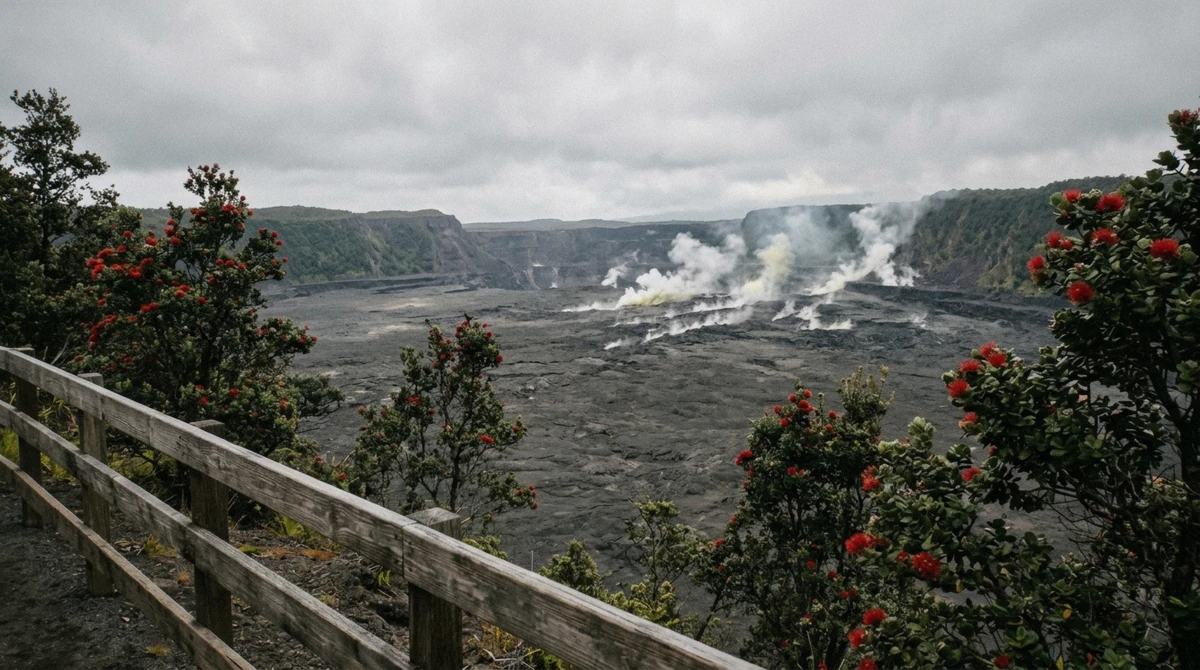
Fountaining Episodes And The Pauses Between
An episode is the working unit of this eruption. Understanding one episode tells you what you might see and how likely it is.
What Happens During One Episode
A fountaining episode generally lasts less than 12 hours. Lava jets from one or more vents in Halemaumau, builds a fountain, throws fragments into the air and feeds flows inside the closed crater area. The most recent episode counted in the observatory sequence, Episode 54, ran about 9 hours.
During it, the north vent fountain reached roughly 500 feet (150 m) and the plume rose to about 17,000 feet (5,200 m). Those are the real dimensions of a summit episode, large enough to bend the light of a night sky and to send a gas plume to airliner cruising altitudes.
- Duration: about 9 hours for Episode 54, generally under 12 hours for the sequence
- Fountain height: roughly 500 feet (150 m) from the north vent
- Plume height: about 17,000 feet (5,200 m)
- Then the vents stagnate and the pause begins
Repose: The Long Part
The quiet stretch between two episodes is called the repose period. In the current eruption it runs two or more weeks. That arithmetic is the single most useful fact for a visitor on a day trip from Oahu. Your whole door-to-door day runs 12 to 16 hours depending on the listing, and the flight from Honolulu to Hilo takes about one hour each way. The chance that your few hours in the park land inside an episode that lasts under 12 hours and comes roughly twice a month is small.
Plan the trip around the park itself, which is open 24 hours a day, 7 days a week, and treats any lava as a bonus. Between episodes the summit still releases 1,000 to 5,000 tonnes of sulphur dioxide a day, so the steam vents and the gas haze are there even when the fountains are not. The crater rim at Halemaumau has been inside a closed area since late 2007 in any case, so viewing is from designated overlooks rather than the edge.
Alert Levels And Aviation Colour Codes
Two scales appear in every observatory update. One is for the ground, one is for the sky, and they do not always move together.
The Volcano Alert Level
The USGS uses a four-step ground scale: NORMAL, ADVISORY, WATCH and WARNING. Kilauea currently sits at WATCH, which means an eruption is underway or the volcano shows heightened unrest with elevated potential. For a visitor, WATCH with episodic lava is exactly the state that has held through the current sequence.
It does not mean the park is closed. Hawaii Volcanoes National Park is open 24 hours a day, 7 days a week, entry costs $30 per private vehicle valid for 7 days, and children under 16 enter free. The eruption area itself is inside a closed zone, and a danger alert for the eruption has stood since it began.
The Aviation Colour Code
The aviation scale also runs green, yellow, orange and red, and it exists for aircraft. Kilauea is at ORANGE, meaning an eruption is underway with limited ash or no ash, or that ash is possible. Episode 54's plume reached about 17,000 feet (5,200 m), which is why the code matters to inter-island flights as well as to visitors.
Neither code is a prediction you can use for your own travel day. They describe the current state, they change with each episode, and the HVO status context is explained more fully on its own page.
| Scale | Steps | Kilauea now |
|---|---|---|
| Ground alert level | NORMAL, ADVISORY, WATCH, WARNING | WATCH |
| Aviation colour code | GREEN, YELLOW, ORANGE, RED | ORANGE |
Tilt, Tremor And Gas
Three words from the observatory updates explain how scientists know an episode is coming before the fountain appears.
Tilt: The Mountain Breathes In
Tiltmeters measure tiny changes in the slope of the ground. Magma rising into the shallow storage system under the summit inflates the surface, and the instruments record a slow swelling, often called inflationary tilt, in the run-up to an episode. When the fountain finally opens and magma leaves the storage area, the trend reverses and the ground deflates.
That inflate-then-drain pattern is one of the clearest signs in the record that an episode is approaching, and it is why the observatory can often give same-day or next-day notice of a fountain even though it cannot schedule one for your holiday.
Tremor: The Sound Of Moving Magma
Tremor is a continuous low-level shaking recorded by seismometers, distinct from discrete earthquakes. During fountaining episodes at the summit, tremor rises as magma moves and gas escapes through the vent. Between episodes it drops back, and the observatory's summaries lean on the combination of tremor and tilt to describe the state of the plumbing.
No numeric threshold values for tilt or tremor are published in the material this page draws on, so treat the words as directions of change rather than numbers.
Gas: The Constant Background
Sulphur dioxide is the third signal. Between episodes the summit releases 1,000 to 5,000 tonnes of the gas a day, which is why you can smell a volcano long after the lava stops. For visitors the park posts a tephra caution at the summit, noting that ash, rock and glassy strands can irritate skin, eyes and airways.
If you are sensitive to volcanic gas, read the safety and gas page before booking, because the fumes are present on quiet days too.
Seeing An Erupting Volcano From Oahu
The honest answer for anyone based on Oahu: there is no active volcano on this island, and the real one is a flight away.
Oahu Has No Active Volcano
Oahu is built from two extinct shields, Waianae and Koolau, and its craters are the last gasp of the Honolulu Volcanics. Diamond Head, Koko Crater, Punchbowl and Hanauma Bay are extinct tuff cones. Walking Diamond Head costs $5 per person on foot or $10 per vehicle, Koko Crater's 1,048 steps are free, and none of it will ever fountain.
If your keyword search started from a Waikiki hotel room, read why Oahu's craters are extinct and set expectations early.
What A Day Trip Costs And Delivers
The lava is on the Big Island, about 215 miles from Honolulu, roughly a one-hour flight each way, with door-to-door days of 12 to 16 hours. The table compares the main fly-in listings on price, park time and review record so you can judge what your money buys before any lava enters the calculation. No listing can promise lava, because no one can, and the Ways to get there guide covers the DIY route as well.
| Tour | Price | Duration | Stated park time | Rating |
|---|---|---|---|---|
| Day tour with hotel pickup | $585 | 12h 30m | Park plus Nahuku and Chain of Craters Road | 4.7 from 70 reviews |
| Polynesian Adventure without helicopter | $576 | 16 hours | Park, Nahuku and Chain of Craters Road | 4.1 from 17 reviews |
| Kona route experience | $589.99 | 12 hours | 2 hours stated | 4.75 from 272 reviews |
Do And Don't: Reading An Eruption Like A Local
Do
- Do check the alert level and aviation code together, because WATCH and ORANGE mean an episodic eruption is underway, not that lava is flowing today.
- Do plan around the park, which is open 24 hours a day with a $30 vehicle entry, because a fountain lasting under 12 hours cannot be scheduled around a 12-hour day trip.
- Do treat the repose period as the normal state, since pauses run two or more weeks between the 54 episodes so far.
- Do book a tour with free cancellation such as the Kona route day trip at $589.99, in case an episode starts the day after you fly home.
Don't
- Don't expect lava on Oahu, because Diamond Head, Koko Crater, Punchbowl and Hanauma Bay are extinct tuff cones with no magma left.
- Don't read a single observatory word such as tremor as a countdown, because the published material gives no numeric thresholds for tilt or tremor.
- Don't enter the closed crater area at Halemaumau, which has been closed to the public since late 2007 regardless of the alert level.
- Don't confuse a WATCH alert level with a WARNING, since WATCH describes the episodic state that has held through this whole eruption.
Questions About What Erupting Means
Is Kilauea erupting right now?
Yes, in the episodic sense. The observatory has Kilauea at WATCH alert level and ORANGE aviation code, with 54 fountaining episodes in the current sequence, but on many days there is no active lava on the ground. The full status page explains the difference.
How long does one erupting episode last?
Generally under 12 hours. The most recent episode counted, Episode 54, ran about 9 hours with a fountain of roughly 500 feet (150 m). Pauses of two or more weeks follow, which is why a single-day trip should never be booked around the hope of a fountain.
What does the WATCH alert level mean for visitors?
WATCH means an eruption is underway or unrest is elevated. It does not close the park, which is open 24 hours a day with a $30 private vehicle fee. What it does close is the crater rim area, shut since late 2007, as covered in the closures and safety notes.
Why does the aviation colour code matter to me?
ORANGE means an eruption is underway with limited ash or the possibility of it, and plumes such as Episode 54's 17,000-foot (5,200 m) cloud can affect inter-island flying. Your own Honolulu to Hilo flight takes about one hour, and the route options are compared here.
Can I see any of this on Oahu itself?
No. Oahu's volcanoes are extinct and its craters are tuff cones, so there is no erupting anything on the island. You can still walk volcanic ground on the Diamond Head crater trail for a $5 entry fee, just not glowing lava.
What is the difference between an episode and an eruption?
The eruption is the whole sequence, running since late 2024. An episode is one fountaining event inside it, and there have been 54 of them, each under 12 hours. The type of volcano involved is a shield with a summit caldera, which is what makes summit fountains possible.