 Oahu Volcano Tours
The Types of Hawaii Volcanoes, From Shields to Tuff Cones
The types of Hawaii volcanoes come down to three shapes: shield volcanoes, tuff cones and cinder cones, plus the calderas that cap the biggest shields. Hawaii is built by all of them, and Oahu, where most visitors start, is built entirely by dead ones. This page defines each type, gives a Hawaiian example you can actually stand on or fly to, and separates what you can walk from what needs a plane. The geology decides your day. If the shape you want to see is a caldera with a live lava lake, that is a 215-mile flight from Honolulu. If a tuff cone trail at sunrise is enough, it costs $5. volcano tours from Oahu compared covers the ways to reach both.
Quick answer The volcano types in brief
Three types build Hawaii: shield volcanoes, tuff cones and cinder cones, with calderas formed by collapse at the summits of the largest shields. Kilauea, a shield, has run 54 fountaining episodes since its eruption began in 2024. Oahu itself holds only extinct examples of the last two types.
Key takeaways
- Oahu has no active volcano, only tuff cones like Diamond Head, which costs $5 per person to enter.
- Shields are the giant type. See how Oahu's two dead shields built the island.
- The live caldera is on the Big Island, a one-hour flight. Compare the day trips from Waikiki.
- For the full picture of which volcanoes are still going, read which Hawaii volcanoes are active.
The Four Terms, One Table
Volcano guides throw around four words and most pages never pin them to places you can visit. The table below does, using only Hawaiian examples, with the entry cost or the size of each one.
Type by Type
A shield volcano is a broad, gently sloping mountain built by runny lava flowing long distances. A tuff cone is a steep, squat ring of ash blasted out when lava met seawater or groundwater. A cinder cone is a small heap of loose fragments around a short-lived vent.
A caldera is not a volcano at all but the collapsed summit crater a great shield leaves behind. Hawaii has famous examples of all four. The figures come from Hawaii state parks, the Honolulu government and USGS records.
| Type | Hawaiian example | Where | Key figure |
|---|---|---|---|
| Shield | Koolau and Waianae | Oahu | Konahuanui, 3,150 feet, is the Koolau high point |
| Tuff cone | Diamond Head | Oahu | Over 475 acres, entry $5 per person |
| Tuff cone (flooded) | Hanauma Bay | Oahu | Hawaii's first Marine Life Conservation District, 1967 |
| Cinder cone | Koko Crater | Oahu | 1,048 steps up a WWII tramway |
| Caldera | Halemaumau, Kilauea | Big Island | Rim closed to the public since late 2007 |
Sources: Hawaii Volcanoes National Park, Hawaii State Parks and the USGS Hawaiian Volcano Observatory.
Shield Volcanoes, the Island Builders
Every Hawaiian island is a shield or a cluster of them. If you learn only one type, learn this one, because it explains the skyline you see from Waikiki.
What a Shield Is
Hawaiian lava is runny by world standards. Instead of piling into a steep cone, it flows outward for miles and hardens in thin sheets. Do that for hundreds of thousands of years and you get a mountain shaped like a warrior's shield lying flat: wide, low-angled, enormous.
Kilauea and Mauna Loa on the Big Island are active shields. Oahu is built from two finished ones, Waianae and Koolau. There is no entry fee to stand on a shield, because you are standing on one all day.
Oahu's Two Shields
The Waianae range holds Mount Kaala, Oahu's high point at 4,025 feet. The Koolau range tops out at Konahuanui, 3,150 feet, and its steep green pali above Honolulu is the eroded wall of the old shield. A guided walk on the Koolau slopes is the cheapest way to feel shield geology underfoot: the Oahu volcanic rainforest hike costs $90, lasts 3 hours 30 minutes and climbs 600 feet with a naturalist who points out the vents and the views to both high points.
Neither Oahu shield will erupt again. USGS records describe both as extinct, which is the single most important geological fact for anyone planning an volcano tours from Oahu compared.
The Active Shields on the Big Island
Kilauea is a shield, and its current eruption, running from vents inside Halemaumau crater since 2024, had produced 54 fountaining episodes by the autumn of 2026. A typical episode lasts under 12 hours, and the gaps between episodes run two or more weeks, so even a booked day trip is a gamble on timing. The national park that protects it charges $30 per private vehicle, valid 7 days, or $15 per person on foot.
The summit area around the eruption is a closed zone.
Tuff Cones, the Craters You Can Walk
Tuff cones are the reason this site exists. Oahu's four most visited craters are all tuff cones, and all of them can be hiked in a morning.
How a Tuff Cone Forms
When magma rises through shallow water or saturated ground, it flashes to steam and tears the rock apart. The explosion throws ash and fragmented rock into a steep ring around the vent, and that ring is a tuff cone. The word tuff refers to the compacted ash the cone is made of.
Unlike a shield, which builds slowly and quietly, a tuff cone is born violently and briefly, often as a single episode. Oahu's tuff cones belong to the Honolulu Volcanics, which USGS material describes as the island's last gasp of activity.
Diamond Head and Hanauma Bay
Both are tuff cones and both are ticketed, but they behave nothing alike as a day out. Hanauma Bay is the one whose seaward wall collapsed and let the ocean in. The figures come from the state and city pages that run each site.
The full trail details live in the Diamond Head crater hike guide.
| Tuff cone | Size or scale | Access |
|---|---|---|
| Diamond Head (Leahi) | Over 475 acres, summit trail 60 to 90 minutes | $5 per person or $10 per vehicle, reservation up to 30 days ahead, arrive inside the first 30 minutes |
| Hanauma Bay | Nearly 845,000 visitors in 2019, close to 3,000 a day, now roughly half that | Wednesday to Sunday, entry 6:45 a.m. to 1:30 p.m. only |
Punchbowl
Punchbowl is the fourth Oahu tuff cone, and it is the one with no trail to a summit because the crater floor holds the National Memorial Cemetery of the Pacific. It costs nothing to enter. The page on Punchbowl crater covers access and etiquette.
What matters for this page is the pattern: three of Oahu's four tuff cones are walkable, one is a place of rest, and none of them is going to erupt. They are between roughly 70,000 and 40,000 years old in the broad literature on the Honolulu Volcanics, though the pack does not give a firm date for any single cone, so treat any precise age you read elsewhere with care.
Cinder Cones, the Small Steep Ones
Cinder cones are the smallest of the three types and the easiest to climb, because they are steep piles of loose rubble rather than solid rock.
What a Cinder Cone Is
A cinder cone forms when gas-rich lava fountains into the air and breaks into clinkers called cinders. They land around the vent and pile into a hill that can grow in weeks, usually a few hundred feet high at most. Unlike tuff cones, they form in dry conditions, without steam explosions.
Hawaii has thousands of small cinder cones on the flanks of its big shields, and the pack names no single one, so no invented example appears here.
The Koko Crater Question
Koko Crater is the one Hawaii landform where the sources in this pack disagree. The USGS-based geology summary lists Koko Crater with Diamond Head, Punchbowl and Hanauma Bay as a tuff cone of the late Honolulu Volcanics. The listing for the guided sunset hike describes it as a cinder cone and calls the climb 1,048 railway sleepers straight up a cinder cone.
That is a conflict, and the honest reading is that the climb is the same either way: 1,048 steps up a WWII tramway to pillboxes and bunkers, with views to Hanauma Bay, Diamond Head and, on clear days, Molokai. Entry is free at Koko Head District Park. The step-by-step detail is in the Koko Head stairs guide.
Calderas, the Collapsed Tops
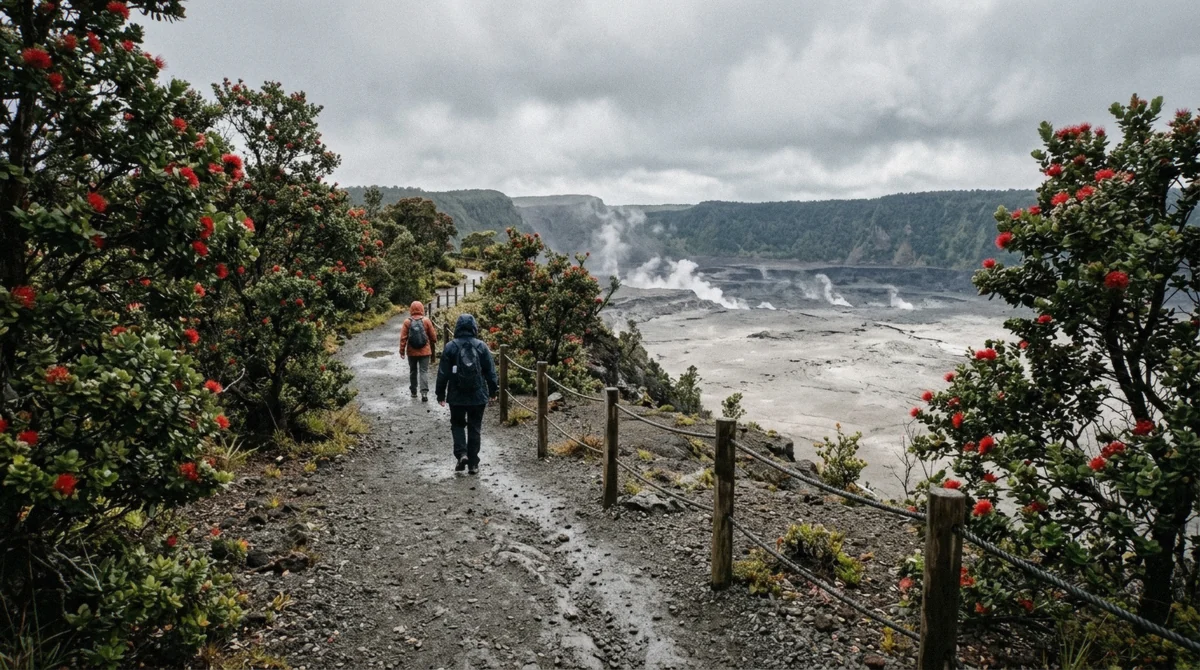
A caldera is what happens when a volcano drains its magma chamber and the summit falls into the hole. Kilauea's caldera and the Halemaumau pit inside it are the Hawaiian examples that matter to visitors.
Halemaumau and the Current Eruption
The current Kilauea eruption, running episodically from vents in Halemaumau crater since 2024, sits inside a caldera. As of the most recent USGS Hawaiian Volcano Observatory update, the alert level was WATCH with aviation colour ORANGE, and no active lava was on the ground at the time of that check, though the vents glowed. Episode 54 ran about 9 hours, with the north vent fountain reaching roughly 500 feet and the plume about 17,000 feet.
Between episodes the summit releases 1,000 to 5,000 tonnes of sulphur dioxide a day. The crater rim has been closed to the public since late 2007, so nobody on a day tour gets to the edge. What tours do deliver is the caldera overlooks and the park around them.
Reaching the Caldera From Oahu
Reaching a live caldera from Oahu means a flight, and the numbers below are the shape of that day. The park itself is open around the clock and does not take cash, so the cost is entirely in getting there.
The Big Island day tour with Waikiki hotel pickup is the only one that returns you to your hotel, and the whole money picture is in the cost breakdown.
| The flight day | Figure |
|---|---|
| Honolulu to Hilo | About 215 miles, roughly one hour in the air each way |
| Door to door | 12 to 16 hours depending on the listing |
| Cheapest listed flight day | $576 |
| With a helicopter | $810 |
| With Waikiki hotel pickup | $585, covering the park, Nahuku lava tube and Chain of Craters Road |
What Each Volcano Type Costs to Visit
The type of volcano you choose decides your budget as much as your itinerary. Extinct cones on Oahu cost pocket money. The live caldera needs a flight, and the fees stack up fast on a long day.
Entry Fees Compared
The figures below are the published entry fees and listing prices for visiting each volcano type from an Oahu base, drawn from state park, city and tour operator listings. Walking into Hawaii Volcanoes National Park on foot costs $15 per person and children under 16 go free, which is why a guided day is mostly paying for the flight and the vehicle rather than the gate.
| Volcano type | Example | Cheapest access | Guided from Oahu |
|---|---|---|---|
| Tuff cone | Diamond Head | $5 per person, $10 per vehicle | $64 with transport |
| Cinder or tuff cone | Koko Crater | Free, no entry fee | $129 sunset hike |
| Shield slopes | Koolau range | Free to walk the range | $90 rainforest hike |
| Caldera | Kilauea summit | $30 per vehicle, $15 walk-in | $576 to $810 by air |
| Flooded tuff cone | Hanauma Bay | Fees on site, cash parking | Roberts package with transport |
The Honest Bottom Line
No tour of any price can promise lava. Fountaining episodes last under 12 hours with pauses of two or more weeks between them, and the eruption area has been closed since late 2007. What $576 to $810 buys is a caldera overlook, steam vents, a lava tube and a black sand beach, all in one 12-to-16-hour day.
What $5 to $129 buys is a real volcanic landform, climbed on your own feet, on your own schedule. Both are honest volcano days. Pick the type first and the budget follows.
Which Type Should You Visit?
Match the volcano type to the day you actually have.
If You want the classic crater hike for pocket money, then climb a tuff cone. Diamond Head costs $5 per person and the sunrise shuttle tour at $64 handles the reservation for you.
If You want the hardest and steepest of the Oahu cones, then take the 1,048-step Koko Crater climb, free to enter, with a guided option at $129.
If You want to stand on the slopes of a great dead shield, then the $90 naturalist walk on the Koolau range covers 3 hours 30 minutes and 600 feet of climbing.
If You want the live caldera and accept that lava cannot be promised, then fly. The Big Island day tour with hotel pickup runs 12 hours 30 minutes at $585.
Types of Hawaii Volcanoes: Questions
What are the main types of volcanoes in Hawaii?
Three types build the islands: shield volcanoes, tuff cones and cinder cones, with calderas formed by collapse at the summits of the largest shields. Oahu holds only tuff cones and cinder or tuff cones of the Honolulu Volcanics, while the active shields and their caldera are on the Big Island. The Oahu volcanic history guide explains how the island moved off the hot spot.
Is Diamond Head a shield volcano or a tuff cone?
Diamond Head is a tuff cone, formed by steam explosions where magma met groundwater, not by the long quiet lava flows that build shields. It covers over 475 acres and its summit trail takes 60 to 90 minutes. The Diamond Head crater hike guide has the reservation rules.
Are there any active volcanoes on Oahu?
No. USGS records describe Oahu as having no active volcano, built instead from two extinct shields, Waianae and Koolau, with the tuff cones of the Honolulu Volcanics as the last activity. The live lava is on the Big Island, a flight away. See which Hawaii volcanoes are active.
Is Koko Crater a cinder cone or a tuff cone?
The sources in this pack conflict. The USGS-based summary groups Koko Crater with Diamond Head and Punchbowl as a tuff cone, while the tour listing calls it a cinder cone. The climb is the same either way, 1,048 steps of WWII tramway. The Koko Head stairs guide covers the route.
What type of volcano is Kilauea?
Kilauea is a shield volcano, and its summit holds a caldera with the Halemaumau pit inside it. It has been erupting episodically since 2024, with 54 fountaining episodes by the most recent update and typical episodes under 12 hours. The page on what erupting actually means explains the cycle.
Can I see all the volcano types in one trip from Oahu?
Yes, in one very long day. You can climb a tuff cone or cinder cone on Oahu in the morning for $5 or free, then fly about 215 miles to Hilo, roughly one hour each way, and stand at a caldera overlook in Hawaii Volcanoes National Park. Realistically that means a guided day of 12 to 16 hours, and the planning guide for the one-day trip lays out the timing.
Which volcano type is safe to hike with children?
The extinct cones on Oahu are the family-friendly type. Diamond Head costs nothing for children 3 and under, and the park entry at Hawaii Volcanoes National Park is free for under 16s, though the day trip itself is a 12-to-16-hour day. The guide to volcano tours with kids compares the options by age.