 Oahu Volcano Tours
Hanauma Bay Crater: The Flooded Tuff Cone And How To Get In
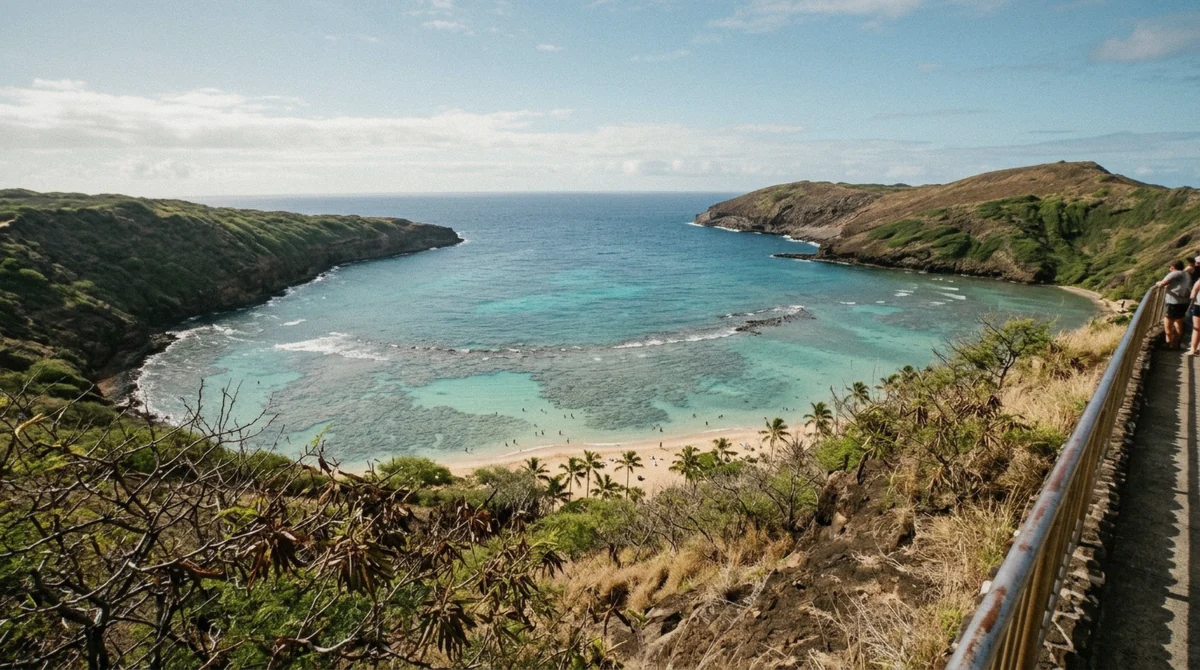
The Hanauma Bay crater is a flooded tuff cone on the southeast corner of Oahu, formed by the short burst of eruptions geologists call the Honolulu Volcanics, the last volcanic activity the island ever produced. The sea broke into the crater and turned it into a sheltered bay, and in 1967 it became Hawaii's first Marine Life Conservation District. This page is about the volcano itself and about the entry system around it, which is the strictest of any crater on Oahu. It is open five days a week, entry stops at 1:30 p.m., and every visitor watches a mandatory education video. For the swimming and reef detail, this is not that page. For lava, see every way to reach a volcano from Oahu options.
Quick answer Entry rules in brief
The Hanauma Bay crater is a flooded tuff cone, and the nature preserve around it opens Wednesday to Sunday with entry allowed only between 6:45 a.m. and 1:30 p.m.
Key takeaways
- Non-residents reserve through the PROS system, which opens two days ahead at 7 a.m. Hawaii time, or book a Roberts Hawaii package with transport up to a month ahead.
- Every visitor watches the education video on every visit, and the beach clears at 3:30 p.m. with everyone out by 4 p.m.
- Hawaii residents with ID, US military and children 12 and under enter free. Free and cheap volcano days are compared on Oahu volcano tours on a budget.
- Want a crater you can climb instead? The Koko Crater sunset hike starts next door, or read the Diamond Head trail guide.
What The Hanauma Bay Crater Actually Is
A short geology lesson that explains the shape of the bay you see from the overlook.
A Tuff Cone, Not A Caldera
Hanauma Bay crater is a tuff cone, built when rising magma met groundwater or seawater and exploded into steam and ash. The ash settled around the vent and hardened into rock. Oahu itself has no active volcano. The island is built from two extinct shields, Waianae and Koolau, and Diamond Head, Koko Crater, Punchbowl and Hanauma Bay are tuff cones of the late Honolulu Volcanics, the island's last gasp of volcanic activity. That last gasp is what carved this coastline.
Because the cone sits right at the shore, the ocean eventually breached its outer wall and flooded the crater floor. What was once a dry ash ring became a bay with a curved sand beach on its inner rim. The highest point on the Koolau shield behind it, Konahuanui, reaches 3,150 feet, and the island's true summit, Mount Kaala, tops out at 4,025 feet. Neither has vented lava in a very long time.
A Protected Crater Since 1967
In 1967 Hanauma Bay was designated Hawaii's first Marine Life Conservation District. That protection is the reason the entry system is strict. The preserve drew nearly 845,000 visitors in 2019, which averaged almost 3,000 people a day, and the pressure on the reef was obvious. Attendance today runs at roughly half that figure, a direct result of the reservation and education rules described below.
For context on how this crater fits the island's story, the volcanic history of Oahu covers the whole timeline, and types of Hawaii volcanoes explains what separates a tuff cone from a shield. If your mental image of Hawaii involves flowing lava, know that it does not happen here. The lava is on the Big Island, about 215 miles from Honolulu, and reaching it takes a flight of about one hour each way. Day trips such as Big Island volcano day tours make that run, but this page stays on the crater itself.
Sources: Hawaii Volcanoes National Park, Hawaii State Parks and the USGS Hawaiian Volcano Observatory.
Opening Hours And The Entry Window
The preserve runs the tightest schedule of any crater on Oahu, and arriving outside the entry window means no entry at all.
Five Days A Week, Not Seven
The preserve opens Wednesday to Sunday. It closes on Mondays, Tuesdays, Christmas Day and New Year's Day. Entry is allowed only between 6:45 a.m. and 1:30 p.m., so a visitor who rolls up at 2 p.m. is out of luck regardless of ticket. Once on the sand, the schedule softens: the beach is cleared at 3:30 p.m. and everyone must be out by 4 p.m. That gives most visitors several hours inside the crater after a morning entry.
Compare that with the other craters. Diamond Head runs 6:00 a.m. to 6:00 p.m. daily, with the last reservation slot at 4:00 p.m. and hikers on the trail by 4:30 p.m. Koko Crater and its 1,048 steps have no entry fee and no gate at all. If a flexible schedule matters more to you than a reef, the Koko Head stairs guide covers the free alternative two ridges away.
The Full Day In Numbers
The table below gathers every hour that governs a visit to the preserve, taken from the City and County of Honolulu's Hanauma Bay Nature Preserve pages. Read it before you book anything, because two of these numbers, the 1:30 p.m. entry cutoff and the two-day reservation window, are the ones that catch people out.
| Rule | Detail |
|---|---|
| Open days | Wednesday to Sunday |
| Closed days | Mondays, Tuesdays, Christmas Day, New Year's Day |
| Entry window | 6:45 a.m. to 1:30 p.m. only |
| Beach cleared | 3:30 p.m. |
| Everyone out | 4:00 p.m. |
| Reservation window | PROS opens two days ahead at 7 a.m. Hawaii time |
| Education video | Mandatory for every visitor, on every visit |
Reservations, The Video And The Payment Details
Nobody walks into the Hanauma Bay crater without a booking or a resident ID, so here is exactly how the system works.
How Non-Residents Book
Visitors who are not Hawaii residents reserve through the city's PROS system. The booking window opens two days ahead at 7 a.m. Hawaii time, which means the popular morning slots go quickly and you need to be online at the minute it opens. Slots are released day by day, so a Wednesday visit goes on sale at 7 a.m. two days before. There is no walk-up lane for non-residents.
The other route is a Roberts Hawaii package with transport included, bookable up to a month ahead. That costs more but removes the 7 a.m. scramble and the parking question in one move. If your dates are tight and the PROS slots vanish, this is the reliable fallback. Booking more than a day ahead matters on Oahu in general, a pattern covered in the advance versus last-minute booking guide.
The Mandatory Video
Every visitor watches the education video on every visit, first-timers and repeat visitors, residents and tourists alike. The video covers the marine life conservation rules and how to behave around the reef. It runs before you go down to the beach, so build it into your morning.
Combine the video with a 6:45 a.m. arrival and you are on the sand early, which is when the preserve is quietest. The rule is a condition of entry, not a suggestion, and there is no exemption for having seen it before.
Money At The Gate
Online payments for the reservation carry a 2.35% service fee. Parking is paid on site in cash, so bring bills, because the card machine will not save you there. The exact parking rate and the standard non-resident entry fee are not stated in the city pages summarised for this guide, so confirm both on the official site when you book.
What is published clearly is who pays nothing: Hawaii residents with ID, US military with military ID, and children 12 and under all enter free.
What A Volcano Day Costs Around The Hanauma Bay Crater
The preserve itself is one of the cheapest volcano experiences on Oahu, and the honest comparison is with the paid hikes next door and the day trips to the Big Island. The figures below come from operator listings and the official park fee pages, and they show how wide the spread is. The cheapest ways onto volcanic ground cost nothing at all, while the day trips that fly to Hawaii Volcanoes National Park start at $576.
Comparing The Options
The table lists the main ways to spend a volcano day from Honolulu, from the free crater hikes to the escorted flights. Koko Crater charges no entry fee. Diamond Head charges $5 per person on foot or $10 per vehicle.
The Big Island day trips range from $576 to $810 and consume 12 to 16 hours door to door. Hanauma Bay's own non-resident entry fee is not stated in the source pages for this guide, so the row flags that.
| Option | Cost | Time needed |
|---|---|---|
| Hanauma Bay crater, non-resident | Entry fee not stated, plus a 2.35% online service fee and cash parking on site | Half day, entry 6:45 a.m. to 1:30 p.m. |
| Koko Crater stairs | Free, no entry fee | 3h 30m guided, or your own pace |
| Diamond Head hike | $5 per person or $10 per vehicle | 60 to 90 minutes on the trail |
| Koolau rainforest hike with guide | $90 | 3h 30m |
| Big Island volcano day trip, cheapest | $576 | 16 hours |
| Big Island volcano day trip with helicopter | $810 | 15h 30m |
The Honest Trade-Off
Hanauma Bay and the other Oahu craters are extinct. There is no lava, no glow and no steam on this island, and no tour can change that. Kilauea on the Big Island has been erupting episodically since 23 December 2024, but a fountaining episode generally lasts less than 12 hours with pauses of two or more weeks between episodes, so even a $810 helicopter day cannot promise lava.
On the day this guide's sources were compiled there was no active lava on the ground at all. If seeing an active volcano is the point of your trip, read which volcanoes in Hawaii are active and the cost of a volcano tour from Oahu before you spend. If a beautiful volcanic crater with the strictest rules on the island is enough, Hanauma Bay delivers.
Do And Don't At The Hanauma Bay Crater
The preserve's rules are enforced, and the two-day booking window punishes improvisation. These points keep the visit simple.
Do
- Do book on the PROS system at 7 a.m. Hawaii time two days before your visit, because that is when slots open and the morning ones go fastest.
- Do arrive inside the 6:45 a.m. to 1:30 p.m. entry window, because the gate does not admit anyone after 1:30 p.m.
- Do bring cash for on-site parking, because the lot is cash only even though the booking fee of 2.35% is charged online.
- Do consider the Roberts Hawaii package with transport, bookable up to a month ahead, if the two-day window does not fit your trip.
- Do watch the education video properly, because it is mandatory on every visit and sets the rules that protect the 1967 conservation district.
Don't
- Don't plan a Monday or Tuesday visit, because the preserve is closed both days as well as Christmas Day and New Year's Day.
- Don't turn up expecting to pay at the gate as a visitor, because non-residents need a reservation and there is no walk-up lane.
- Don't plan to stay past 4 p.m., because the beach clears at 3:30 p.m. and everyone is out by 4 p.m.
- Don't expect lava here, because Hanauma Bay crater is extinct and the active eruptions are a flight away on the Big Island.
Hanauma Bay Crater Questions
Is the Hanauma Bay crater an active volcano?
No. Hanauma Bay crater is a tuff cone of the late Honolulu Volcanics, Oahu's last period of activity, and Oahu has no active volcano today. The active eruption is Kilauea on the Big Island, which the Big Island day trips from Oahu fly you to.
What days and hours is the Hanauma Bay crater open?
Wednesday to Sunday, with entry allowed only between 6:45 a.m. and 1:30 p.m. The beach clears at 3:30 p.m. and everyone is out by 4 p.m. It closes Mondays, Tuesdays, Christmas Day and New Year's Day, a schedule you can set against the other craters in the Oahu volcano tours by season planner.
How far ahead do I need to reserve for Hanauma Bay?
Non-residents book through the PROS system, which opens two days ahead at 7 a.m. Hawaii time. If that window is impossible for you, a Roberts Hawaii package with transport can be booked up to a month ahead, one of the options compared in every way to reach a volcano from Waikiki.
Do I really have to watch the video every visit?
Yes. Every visitor watches the education video on every visit, with no repeat-visitor exemption. It is a condition of entering the preserve, which has been Hawaii's first Marine Life Conservation District since 1967. The reasoning behind such rules is covered in the volcano safety guide.
Who gets into Hanauma Bay for free?
Hawaii residents with ID, US military with military ID, and children 12 and under all enter free. Everyone else reserves and pays online, where a 2.35% service fee applies, with parking paid in cash on site. More free and low-cost crater days are listed on Oahu volcano tours on a budget.
Can I see the Hanauma Bay crater without swimming?
Yes, the crater rim and overlook show the flooded cone and the bay inside it, and the entry system is the same for every visitor. For a crater you can actually climb, the Diamond Head sunrise hike tour or the free Koko Crater stairs put you on volcanic rock instead of in the water.
How many people visit the Hanauma Bay crater each day?
Nearly 845,000 people visited in 2019, averaging almost 3,000 a day, and attendance today runs at roughly half that thanks to the reservation rules. Crowds across the island's crater sites shift through the year, which the best time to visit Oahu volcanoes page breaks down season by season.