 Oahu Volcano Tours
What to Eat Before a Volcano Hike on Oahu
What to eat before a volcano hike on Oahu comes down to one problem: the day starts before anything is open. The Big Island day trips leave Waikiki between 4 and 5 a.m., and the Koko Crater stair climb runs to sunset, so you cannot count on buying breakfast or dinner where you happen to be. This page works through the timing for both days. It lists which tour listings include food and which do not, the fees you may need cash for, and the places inside each day where you can actually buy a meal. None of the Oahu craters sell food on site, so every plan starts with what you carry, and it sits alongside the tours and craters compared.
Quick answer Food around a volcano day
Eat a solid breakfast before a 4 a.m. pickup, carry snacks for the middle of the day, and expect to pay for lunch yourself wherever the day stops, since no Hilo listing includes it. Only the Polynesian Adventure days include a picnic lunch. Nothing is sold inside Hawaii Volcanoes National Park beyond the visitor center concessions, and the park itself is cashless.
Key takeaways
- Only From Oahu: Big Island Volcano Adventure and From Oahu: Big Island Volcano Adventure include a picnic lunch, so you buy food on the other seven listings.
- For the Oahu climbs, food is on you entirely. See the Koko Crater stairs guide for what the 1,048-step climb demands.
- Carry a small amount of cash anyway. The national park is cashless, but Hanauma Bay parking is paid on site in cash.
- For gear as well as food, read the what to wear checklist.
The 4 A.M. Problem
Every food decision on this page flows from one fact: the day starts before kitchens do.
Why breakfast cannot wait
The Big Island day trips run 12 to 16 hours door to door, flying the roughly 215 miles from Honolulu to Hilo or Kona in about an hour each way. To make a morning flight you clear airport security before dawn. Several listings, including the 16-hour Polynesian Adventure day, state plainly that you arrange your own ride to Honolulu airport at 4 a.m. At that hour almost nothing in Waikiki is serving. Convenience stores open and hotel coffee kiosks sometimes start around 5 or 6 a.m., but there is no published opening hour in any listing you can rely on.
The practical answer is to buy breakfast the evening before and keep it in your room. Something you can eat while waiting for a ride, with no preparation, is the whole job. A bakery item, a banana and a bottle of water covers the first three hours of a 15-hour day.
How much to eat before climbing
On Oahu itself the same early-start logic applies to the sunrise hikes. The Diamond Head shuttle tour picks up at 5:00 to 5:10 a.m. from seven Waikiki locations, which means breakfast happens in a hotel room in the dark. The hike itself takes 60 to 90 minutes over 0.8 miles of paved and stepped trail, so you do not need a large meal, but an empty stomach at 5 a.m. makes for a miserable sunrise.
Koko Crater is a different animal. The 1,048 steps up the old Second World War tramway are the steepest walk on this site, and there is no entry fee and no shop at Koko Head District Park to soften the climb. The guided sunset version runs 3 hours 30 minutes and includes no food or drink at all, so everything you want at the summit bunkers goes up in your own pack. Water matters more than food on that one. A salty snack in a pocket is enough for most people on a climb of that length.
Sources: Hawaii Volcanoes National Park, Hawaii State Parks and the USGS Hawaiian Volcano Observatory.
What the Tour Listings Actually Include
Lunch is the exception, not the rule, across the day trips from Oahu.
The full comparison
The listings are explicit about food, and the split is easy to state. Only the two Polynesian Adventure days bundle a picnic lunch in the park. Every other listing either says meals are not included or says nothing at all, which you should read as not included.
On the Hawaii Island Experiences day, the Hawaii Island Experiences day, lunch takes the form of a stop at the Punaluu bake shop on the drive across the island from Kona, so you pay for your own meal at that stop. The table gathers what each listing states, with prices drawn from the listings themselves.
Reading the price with food in mind
Once you know lunch is out, budget for it. A bakery or market lunch on the Big Island will not change which tour you pick, but it explains part of the gap between a $576 day with a picnic included and a $585 day without one. The cost breakdown page works through the full arithmetic, including park entry at $30 per private vehicle or $15 per walk-in if you drive yourself.
Note that the $576 and $585 figures are the listing prices, and both come with different cancellation terms: the Polynesian day is free to cancel up to 24 hours ahead, the Tournet day is non-refundable at any notice.
| Tour | Price | Duration | Food stated in listing | Cancellation |
|---|---|---|---|---|
| Tour 1: Tournet day tour | $585 | 12h 30m | Lunch not included | Non-refundable |
| Tour 2: Volcano Adventure and Helicopter | $810 | 15h 30m | Picnic lunch in the park | Free cancellation 24h |
| Tour 3: Volcano Adventure | $576 | 16 hours | Picnic lunch in the park | Free cancellation 24h |
| Tour 4: Small group from Kona side | $590 | 12 hours | Meals not included | Free cancellation 24h |
| Tour 5: Dynamic Tour USA | $680 | 1 day | Lunch and tips out | Non-refundable |
| Tour 6: Volcanic rainforest hike | $90 | 3h 30m | No food included | Free cancellation 24h |
| Tour 7: Koko Crater sunset | $129 | 3h 30m | Food and drink not included | Free cancellation 24h |
| Tour 8: Diamond Head shuttle | $64 | 3 hours | No food included | Free cancellation 24h |
| Tour 9: Hawaii Island Experiences | $589.99 | 12 hours | Punaluu bake shop stop, meal at your cost | Free cancellation 24h |
The picnic lunch, described
The picnic lunch on tours 2 and 3 is eaten in Hawaii Volcanoes National Park, between stops that can include the Nahuku lava tube, Chain of Craters Road and the Kilauea Visitor Center. Tour-2 states 3 hours 50 minutes inside the park, the longest of any listing, which gives the picnic a proper slot in the day. Tour-3 covers the park, the lava tube and Chain of Craters Road across a 16-hour total, so the lunch break is the one guaranteed sit-down meal from about 4 a.m. until you land back in Honolulu late at night.
If you have dietary needs the listings do not describe the picnic contents, so the only safe move is to ask the operator at booking rather than assume. Neither listing offers a vegetarian or allergen option as a stated inclusion.
Cash, Cards and What the Park Does Not Sell
Payment rules catch people out on both islands, and food is usually where it bites.
The cashless park and the cash parking lot
Hawaii Volcanoes National Park does not accept cash. Entry is $30 per private vehicle, $25 per motorcycle, $15 per person on foot, and free under 16, all card only. If your day trip includes admission, which most listings do, you never see that transaction. If you drive yourself you tap a card at the gate.
Hanauma Bay works the other way round. Online reservations there carry a 2.35 percent service fee, but parking is paid on site in cash. Anyone planning a morning at the bay before an afternoon hike should carry small bills for the lot. Hanauma Bay admits non-residents only from 6:45 a.m. to 1:30 p.m., the beach clears at 3:30 p.m. and everyone is out by 4 p.m., and it closes Mondays and Tuesdays. Children 12 and under enter free. The Hanauma Bay guide covers the reservation system in detail.
What the craters sell
The short answer is nothing. Koko Head District Park is free and has no food outlet stated. Diamond Head opens 6 a.m. to 6 p.m. daily with entry at $5 per person or $10 per vehicle for non-residents, and no food service is stated in the state park information.
The monument covers over 475 acres and closes on Christmas Day and New Year's Day, with the Department of Defense securing the park after 6 p.m., so there is no evening kiosk to rely on either. Every calorie on an Oahu crater day is one you brought or one you buy before or after. That is why the buy-the-night-before rule matters even for a short 3-hour outing.
Where food actually appears on the Big Island day
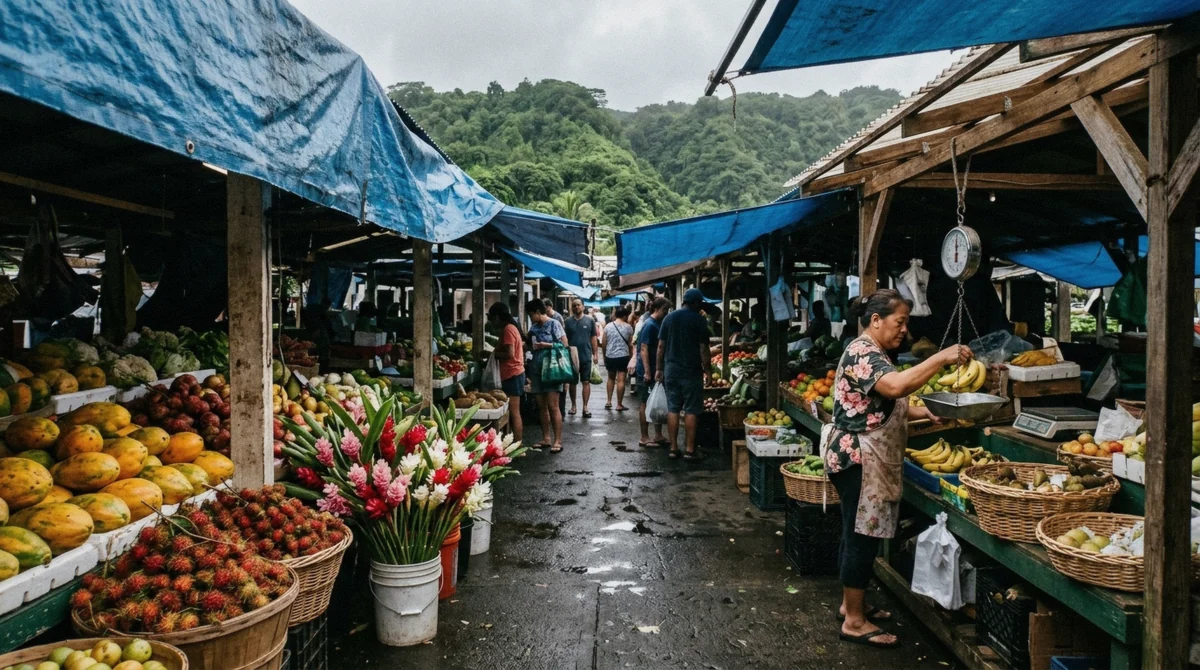
On the listings without included lunch, meals happen in one of three places. Tour-9 stops at the Punaluu bake shop en route from Kona across the island, which is the only named food stop in any listing. Tour-1 builds a Hilo loop that includes the farmers market, so food is purchasable there during the town portion of the day.
Tour-4 crosses the island through the Kona coffee belt and Punaluu black sand beach, but states only that meals are not included without naming where you could buy one. If a guaranteed sit-down lunch matters to you, tours 2 and 3 remain the only listings that promise one, and the helicopter on the helicopter day is the subject of a listing contradiction worth checking at checkout.
What to Carry in the Pack
A short list of food that survives 15 hours, two flights and a climb.
The practical list
Nothing on this list needs refrigeration, cutlery or a table. It is built around the shape of the day: meals at hours you did not choose, long coach and plane stretches, and stops where the only food might be a bake shop counter.
- Breakfast for the 4 a.m. start, bought the evening before and eaten in the room or the ride
- One litre of water per person as a floor, more for the Koko Crater climb
- Salty snacks for the middle hours, since airline and coach food service is not part of any listing
- A sandwich or wrap packed in the morning if your tour has no lunch, eaten at whatever stop allows it
- Something sweet for the late-afternoon slump around hour ten of the day
- Small bills for cash-only parking at Hanauma Bay and for the farmers market on the Hilo loop
Eating and the summit conditions
Two site conditions affect what you pack. First, at the Kilauea summit the park posts a tephra caution: ash, rock and glassy strands can irritate skin, eyes and airways, so food is best eaten inside a vehicle or a building rather than at an exposed viewpoint. Second, between eruption episodes the summit releases 1,000 to 5,000 tonnes of sulphur dioxide a day, which is another reason not to linger over an open picnic at the crater rim, especially since the Halemaumau crater rim has been closed to the public since late 2007 anyway.
The safety page covers the gas question fully. The fountaining episodes themselves generally last under 12 hours with pauses of two or more weeks between them, so no meal plan should be built around watching one.
A Fed Timeline for the 16-Hour Day
This timeline follows the longest listing, the 16-hour Polynesian Adventure day, and slots food into the gaps the operator leaves.
-
03:30
Eat in the room
The listing tells you to arrange your own 4 a.m. ride to Honolulu airport. Breakfast happens before that, from food bought the previous evening.
-
04:00
Ride to the airport
Carry water and a snack in your day pack from here on. Checked bags are not the place for food on a one-day trip.
-
06:00
Flight to Hilo
About one hour in the air over the roughly 215-mile route. No meal service is stated on any listing.
-
09:00
Snack on the coach
The Hamakua Coast drive eats the morning. A salty snack now keeps you even until the picnic.
-
12:00
Picnic lunch in the park
The included lunch lands mid-day between the lava tube and Chain of Craters Road stops. This is the only guaranteed sit-down meal of the trip.
-
15:00
Water at the stops
Keep drinking through the afternoon park stops. Eaten food does little if the water runs out.
-
17:00
Something sweet
Hour thirteen is where the sugar helps. Anything small from your pack works, or buy at Hilo if the day routes through town.
-
21:00
Fly home, eat late or sleep
You land in Honolulu close to midnight on a 16-hour listing. Either plan a late meal near your hotel or accept that breakfast tomorrow is the next real meal.
Food Do's and Don'ts for a Volcano Day
The mistakes on this page all come from assuming food will be available somewhere it is not.
Do
- Do buy breakfast the night before because nothing at a 4 a.m. Waikiki pickup hour is reliably open.
- Do carry small bills because Hanauma Bay parking is paid on site in cash even though the park gate itself is card only.
- Do pick tours 2 or 3 if a guaranteed lunch matters because they are the only listings with a picnic included.
- Do pack more water than food on the Koko Crater stairs because 1,048 steps with no shade and no shop punish dehydration first.
Don't
- Don't plan to buy lunch inside Hawaii Volcanoes National Park on a self-drive day because the park accepts no cash and the listings name no food outlet beyond the visitor center area.
- Don't picnic at the crater rim because the summit posts a tephra caution and releases up to 5,000 tonnes of sulphur dioxide a day between episodes.
- Don't assume the Hawaii Island Experiences day bake shop stop is a free meal because the listing has you paying for your own food there.
- Don't bank on seeing lava with your dinner because fountaining episodes last under 12 hours with pauses of two or more weeks, so no schedule can promise one.
Food Questions
Do any volcano tours from Oahu include lunch?
Yes, two. The Polynesian Adventure days both include a picnic lunch in Hawaii Volcanoes National Park, at $810 with a helicopter and $576 without. Every other listing states meals are not included.
What should I eat before the Koko Crater stair climb?
A normal breakfast an hour or two before, plus water you carry yourself. The Koko Crater stairs are 1,048 steps with no fee and no food outlet at the park, so a salty snack in a pocket is the summit provision.
Can I buy food inside Hawaii Volcanoes National Park?
The listings name no food outlet in the park, and the park itself does not accept cash. Bring your own food or buy at the Punaluu bake shop stop or the Hilo farmers market where the itinerary allows.
Where does the 4 a.m. pickup leave me for breakfast?
Nowhere reliable. Multiple listings, including the 16-hour day, have you arranging your own ride to Honolulu airport at 4 a.m., so breakfast is whatever you bought the evening before and ate in your room.
Do I need cash for a volcano day trip from Oahu?
A little, yes. Hawaii Volcanoes National Park is cashless with entry at $30 per vehicle, but Hanauma Bay parking is paid on site in cash, and cash is useful at the Hilo farmers market.
Is there anywhere to eat at Diamond Head?
No food service is stated at the monument. It opens 6 a.m. to 6 p.m. with entry at $5 per person for non-residents, and the Diamond Head hike guide covers the reservation you need before you go, so plan to eat in Waikiki before or after.
What food should I pack for a guided rainforest hike on Oahu?
Water and one snack. The guided rainforest hike runs 3 hours 30 minutes with about 3 hours on the trail and 600 feet of climbing, includes no food, and supplies rain gear and a hip pack instead, so your own snack rides in that.